A cyclone that made landfall in Andhra Pradesh has exposed Odisha’s decaying disaster management institutions — and the question its politics has so far refused to answer.
Dhanada K Mishra, Hong Kong, 13 November 2026
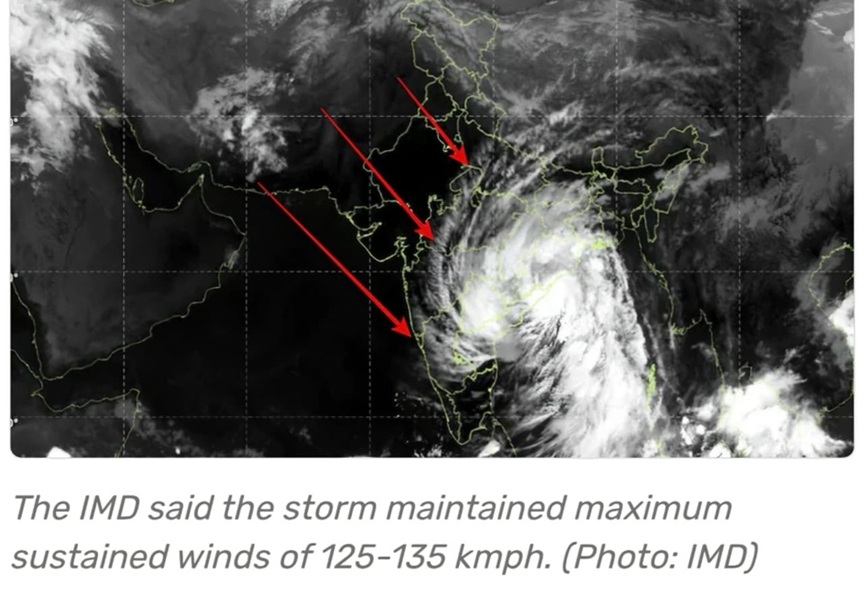
When Cyclone Arnab came ashore in the early hours of 28 October 2026, it did not land in Odisha. It crossed the Andhra Pradesh coast near Yanam, its 125–135 kmph winds tearing through Konaseema and West Godavari. Yet a week later, it was Odisha counting its dead in a landslide at Gidipabali in Ganjam, Odisha whose southern districts lay under floodwater reaching the first floor, and Odisha whose normally stoic people were, for the first time in living memory, shouting in the faces of the politicians and officials who came to survey the wreckage. A storm that made landfall in a neighbouring state had laid bare the condition of this one’s institutions. Disasters do not test the weather. They test governance.
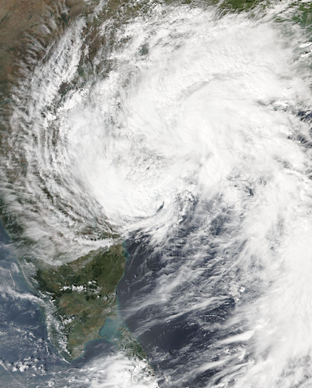
Cyclone Arnab over the Bay of Bengal on 28 October 2026, the day it made landfall on the Andhra Pradesh coast. Image: VIIRS imagery from NOAA’s NOAA-21 satellite via Wikimedia Commons (public domain).
The institution built from tragedy
For a quarter of a century, Odisha’s answer to that test was the envy of the world — because the state had learned it the hardest way possible. On 29–30 October 1999, the Supercyclone, still the worst natural disaster in the state’s history, killed close to ten thousand people and destroyed some two million homes. The trauma produced something rare in Indian administration: an institution. Within two months, on 28 December 1999, Odisha created the Odisha State Disaster Management Authority — India’s first state-level disaster agency, years ahead of the national framework that followed.
Over the next two decades, OSDMA built the architecture that became world-famous: hundreds of cyclone shelters, last-mile early warning with sirens in village after village, evacuation roads, and above all a machinery that moved roughly a million people to safety before Cyclone Phailin in 2013 and did it again before Cyclone Fani in 2019. The United Nations called Phailin’s evacuation a “landmark success story”; for Fani, the UN’s disaster-risk body praised the “almost pinpoint accuracy” of the warnings and the “zero-casualty” approach that followed. Odisha had done what a poor state in a developing country was not supposed to be able to do — and the world had said so.
The point worth underlining about that achievement is that it was institutional, not personal. It belonged to a system: to OSDMA, to the district machinery, and to the thousands of community volunteers, the women’s self-help groups, the village-level warning systems and the twice-yearly mock drills that kept them sharp. Institutions, however, do not stay strong by inertia. They have to be maintained — and Arnab suggests that, at every level, the maintenance has stopped.
An instrument left to rust
Consider the smallest, most telling symptom. The Doppler weather radar at Gopalpur — the instrument that watches the very stretch of the Bay of Bengal where Arnab brewed — was installed in 2017 and has spent much of its life broken. It was down again as recently as September, just weeks before the cyclone season’s most dangerous month, the latest in a long series of technical failures whose repair has become a recurring, long-awaited saga. Early warning is the first link in the entire disaster chain, and it depends entirely on such instruments working. A radar left unrepaired month after month is not a technical glitch; it is a statement about where disaster preparedness sits on the state’s list of priorities.
Around that single failing radar the larger pattern is visible: an ageing early-warning network awaiting an upgrade that keeps slipping, and a response to Arnab that — however sincerely — evacuated tens of thousands and then struggled to reach them with relief, leaving over a hundred villages marooned and public patience exhausted. That patience snapped in a way Odisha has not seen in living memory. Ministers were met with angry crowds at Hinjili; a legislator was heckled and had to be escorted from a village after residents raised slogans about relief that never came; a police complaint was filed against an MLA in a dispute over who got help first; an official was transferred after residents vented their fury over urban flooding.
None of this is merely a political story. Odisha’s people have historically absorbed cyclones with a discipline that was itself part of the state’s disaster narrative. When that forbearance breaks, something structural — not circumstantial — has failed.
A climate the model was not built for
Part of that structural failure is that the ground beneath the model has shifted while the model has not. The climate that produced the 1999 Supercyclone is not the climate Odisha now faces. Warming seas are loading more energy into Bay of Bengal cyclones; the trend of recent decades is not necessarily more storms, but stronger, longer-lived ones, with rapid intensification becoming more common. The El Niño–Southern Oscillation still shapes the season — and it is La Niña conditions, not El Niño, that typically favour post-monsoon cyclones in the Bay — but the underlying warming means every favourable year is now more dangerous than it used to be.
A preparedness system calibrated for the last century’s storms is a system calibrated for a milder world than the one that now exists. That points to two necessities. First, preparedness cannot merely be maintained; it must be continuously raised. Second, the physical fabric itself — embankments, drainage, power lines, the buildings people shelter in — must be redesigned to withstand impacts that are becoming routine rather than exceptional. Adaptation is no longer an emergency-management question. It is a capital-investment question, and it has to be answered at the design stage, not the relief stage.
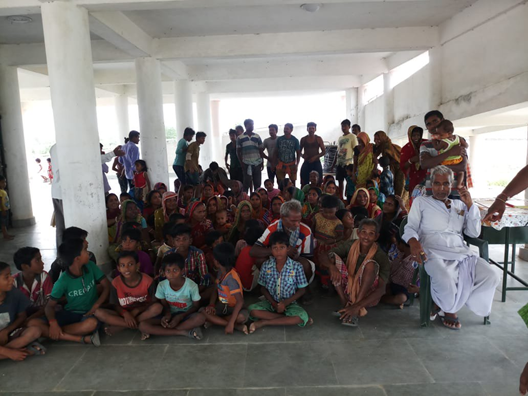
Evacuees at a cyclone shelter in Basudevpur, Bhadrak — the community-level shelter network that underpinned Odisha’s post-1999 ‘zero-casualty’ model. Image: Government of Odisha via Wikimedia Commons (CC BY 4.0).
The question of where power sits
But the deepest lesson of Arnab is not about weather or infrastructure. It is about where power sits. The post-1999 model, at its best, was genuinely decentralised: its last mile was made of village sirens, community volunteers and self-help groups who knew their own neighbours and could act before the state arrived. That is why it worked. In the years since, the tendency has run the other way — toward decisions taken farther and farther from the people they affect.
The result is precisely the anger Arnab has revealed: people who were made to wait for “the administration” to rescue them, and an administration too distant and too slow to reach them. The public’s wrath is not, at bottom, about relief packets or flooded streets. It is the sound of people who have been made dependent on a state that then failed them — and who know it.
The answer is not merely better administration; it is different administration. The constitutional machinery for it already exists in the three-tier panchayati raj system, but it has never been given the substance that disaster resilience requires. Preparedness and first response should be pushed down to the panchayat and the community, with the authority, the funds, the training and the equipment to match. A village that can warn, evacuate and sustain itself for the first 72 hours does not stand in the street waiting for a helicopter or a minister. That is both better disaster policy and better democracy — and it is the only answer that addresses the real grievance behind the anger.
What Arnab teaches
Odisha does not need to relearn the lesson of 1999; it taught that lesson to the world. What it needs is to remember that the lesson was never “build an authority and be done.” It was: build the institution, maintain the institution, and keep its capacity where the people are. Cyclone Arnab did not defeat Odisha’s model by its intensity. It exposed a model that had been allowed to rust while the climate it was built for disappeared. The next storm will not wait for administrative reform. The only question is whether Odisha rebuilds before it arrives — or waits to be angry again.