The Nirvik Bureau, Bhubaneswar, 16 November 2026
Fifteen announcements, several celebrations, and one inconvenient primary problem
In a major breakthrough for education, the Odisha government has announced that the teachers’ problem has been addressed. Teachers who believe otherwise are requested to consult the announcements rather than their salary slips.
The package contains 15 measures, a reassuring number suggesting that somebody has counted something. Whether the government and teachers are counting the same things remains outside the present syllabus.
An administrative committee examined the demands and produced recommendations. This is how governance converts a protest into paperwork: first the teachers stand outside the office; then their demands sit inside it.
Regular salaries: a bold experiment
Among the beneficiaries are staff at 194 high schools, some of whom, according to their association, spent 20 to 25 years working without salaries.
The government now proposes to pay them.
Economists may wish to study this revolutionary arrangement in which employees perform work and subsequently receive money. Should the experiment succeed, it could transform the relationship between employment and survival.
The teachers concerned have expressed gratitude, demonstrating that the most effective way to generate appreciation for a salary is to withhold it long enough for payment to resemble a scholarship.
Their students will also receive benefits such as scholarships, uniforms and mid-day meals. At last, the education system is moving towards the radical position that both children and the adults teaching them should be able to eat.
Your existing entitlement, now available as a special announcement
Primary teachers, however, have proved disappointingly resistant to celebration.
They point out that regular promotions are already their entitlement. This overlooks a fundamental administrative principle: an entitlement becomes a benefit when announced from a sufficiently important podium.
Their demands include higher grade pay and counting the first six years of service towards service benefits.
Those six years present a fascinating philosophical problem. The teachers remember teaching. Presumably, the pupils remember being taught. But can service truly exist before the appropriate administrative recognition?
Until this is settled, the period may be classified as an extended rehearsal involving actual children.
Artificial intelligence arrives; natural grievances remain
The government also plans AI and robotics laboratories in model schools.
This is welcome news. Future robots could perform essential educational tasks such as identifying which category of teacher is entitled to which benefit under which arrangement.
An advanced model might even answer the question, “When will my arrears arrive?” without immediately recommending another committee.
Meanwhile, art, music and sports teachers will see monthly remuneration rise from Rs 10,000 to Rs 16,000. They can now practise the interdisciplinary skill of stretching a budget, setting it to music and running after pending payments.
The next lesson will be held outside
With nearly 80 teachers’ associations, achieving universal satisfaction was always ambitious. The government has instead secured something more manageable: gratitude from one section and notice of another agitation from another.
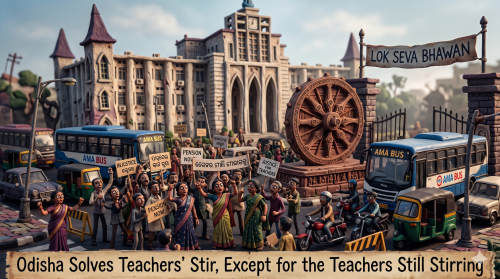
Primary teachers plan fresh protests during the Assembly session, ensuring that practical lessons in democracy continue even when classroom teaching suffers.
The children, meanwhile, await the next chapter.
It is called “Implementation.”
No examination date has been announced.