
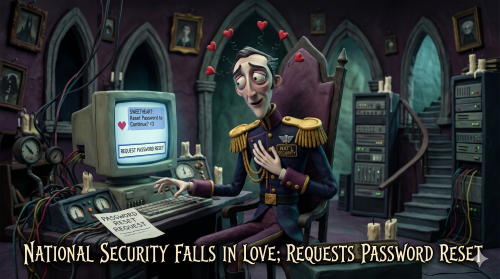
The Nirvik Bureau, Bhubaneswar, 13 November 2026
The Oldest Security Breach Has Excellent Eye Contact
Human civilisation has spent centuries protecting secrets with walls, safes, passwords and encryption, only to hand them over to someone who says, “You’re so much more interesting than the other men at this conference.”
This is the honeytrap: the remarkable discovery that a person who distrusts every foreign government may nevertheless trust a flattering stranger who joined the internet yesterday.
The fictional Ministry of Strategic Affairs has now classified romance as a critical infrastructure vulnerability.
“We can secure the building,” a spokesperson explained. “Unfortunately, the deputy director keeps taking his ego outside.”
From Candlelight to Cloud Storage
In the old days, espionage required effort. Operatives learned languages, attended diplomatic receptions and endured military officers explaining cavalry movements over dinner.
Today, the same operation begins with a connection request.
“Hello, distinguished thought leader. Your insights into semiconductor procurement moved me deeply.”
The target, whose own family has never voluntarily listened to his insights into semiconductor procurement, immediately recognises a profound intellectual connection.
Within minutes, he is discussing classified matters with someone whose profile photograph has six fingers and whose university is listed as “Oxford Harvard Institute of Excellence.”
Technology has truly democratised access.
Romeo, Romeo, Wherefore Art Thy Clearance?
History’s romantic agents understood something modern management consultants charge heavily to explain: relationships matter.
A patient operative might spend years cultivating affection. Contemporary organisations would find this intolerably inefficient.
“Three anniversaries and still no naval codes?” asks the handler. “We need measurable deliverables.”
Love is now monitored through a dashboard:
- Emotional dependence: above target.
- Confidential attachments: pending.
- Flowers: over budget.
- Marriage proposal: awaiting legal review.
The operative requests an extension, explaining that genuine intimacy takes time.
Headquarters suggests a webinar.
The Executive Who Could Spot Every Threat Except Admiration
At the fictional chip company NeuroPeacock, the chief executive regularly warned employees about suspicious emails.
He then met someone who described his keynote presentation as “sensual.”
An internal investigation subsequently established that seventeen security protocols had been followed, except the one involving the chief executive.
“He wasn’t careless,” the board clarified. “He was operating at a level of personal confidence beyond the scope of our controls.”
The cybersecurity department had installed firewalls, biometric locks and round-the-clock monitoring. Nobody had budgeted for a person whispering, “You must be terribly lonely at the top.”
Please Accept These Terms of Endearment
Governments have responded with mandatory romance-awareness training.
Employees must now report unexpected compliments, unusually attentive strangers and anyone who finds budget-allocation meetings fascinating.
Before a first date, staff must complete Form 14B: Declaration of Potential Mutual Attraction.
Second dates require counterintelligence clearance. Falling in love requires approval from three departments, two of which are on leave.
Meanwhile, the ministry has issued its strongest advice yet:
“Never confuse being understood with being assessed.”
The memo was widely praised.
Then the minister received a message saying he looked younger than his official photograph.
He clicked immediately.