The Nirvik Bureau, Bhubaneswar, 8 November 2026
A Festival of Slightly Restricted Visibility
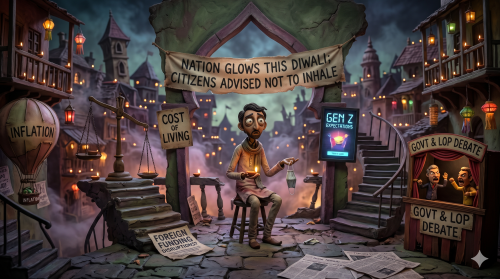
This Diwali, the capital achieved what generations of philosophers could not: it dissolved the distinction between earth and sky. Both were now the same reassuring shade of administrative grey.
Citizens who complained of burning eyes were advised to stop looking at negative things. Those reporting difficulty breathing were reminded that the nation had already taken several historic strides forward; surely they could manage one small breath.
An official clarified that the air was not poisonous. It was aspirational: densely packed with the particles of development.
In Chandni Chowk, overhead wires had grown so luxuriantly that the municipal authorities were considering declaring them an urban forest may be taken from the concept of urban naxals. A proposal to untangle them was rejected because nobody could establish which department owned the original knot.
The Foreign Hand Gets a Permanent Contract
Meanwhile, the Ministry of Unexplained Explanations announced that the Foreign Hand had returned.
It had apparently financed protests, influenced unemployed graduates and persuaded examination papers to leave secure buildings before examination day.
Asked why such a powerful adversary had not been arrested, a spokesperson explained that the Foreign Hand was extremely difficult to identify because it wore different gloves.
“Sometimes American, sometimes Pakistani, occasionally whatever fits the evening debate.”
A journalist asked whether evidence would be released.
“Certainly,” the spokesperson replied. “We have released the allegation repeatedly. Please keep up.”
Cockroaches Demand Jobs; Nation Demands Their Passports
The Cockroach Janta Party created particular alarm by displaying the suspicious ability to survive adverse conditions.
Its young supporters had endured cancelled examinations, leaked papers, recruitment delays and the experience of being told that unemployment was merely an entrepreneurial opportunity without customers.
This resilience immediately raised questions.
“How are they still here?” asked a television anchor. “Who is funding their persistence?”
A graduate explained that he had attended the protest because he wanted a job.
The anchor interrupted: “That is precisely what a foreign-trained job-seeker would say.”
Investigators subsequently discovered that several protesters possessed foreign-made phones, while one had eaten noodles.
The noodles angle was being pursued vigorously.
Democracy Saved Between Tea and Dinner
A senior minister, who had previously invited protest leaders for tea, clarified that hospitality should not be confused with approval.
“The tea was Indian,” he said. “Their intentions may have been imported.”
Asked whether suspected foreign agents routinely received ministerial refreshments, officials announced a comprehensive review of biscuit security.
Elsewhere, democracy was rescued by a procession of very important people who had temporarily left their offices to warn citizens about the dangers of gathering outside theirs.
A Small Administrative Oversight
At last, someone suggested publishing the evidence, cleaning the air, securing examinations and filling vacancies.
The meeting fell silent.
These were complicated proposals involving departments, deadlines and measurable results.
Fortunately, a consultant found a simpler solution.
By evening, the government had launched a portal inviting unemployed young people to report suspicious foreign interference in their lives.
The portal crashed immediately.
An inquiry was ordered into who had financed the traffic.