Dr Manoj Dash, Bhubaneswar, 15 July 2026
Sociologists have often observed that “the market thrives where the state vacates.” The recurring incidents of paper leaks, sudden examination cancellations, and the tragic loss of students’ lives across India represent far more than administrative failures. They expose deeper structural fractures within our educational, economic, and social frameworks. An examination, which should ideally be an instrument for learning and self-improvement, gradually becomes a battlefield where aspirations, parental expectations, economic insecurity, and social competition collide.
Through a three-part series, the author explores the evolving meaning of examinations:
Part-1: What was the ancient philosophical meaning of examination in the Indian context?
Part-2: How did examination systems develop across civilizations over centuries?
Part-3: How can India respond to modern examination challenges with greater wisdom and maturity?
Let us begin by exploring the first question in this part.
A Crisis Beyond Modern Examinations
The crisis involving examinations has not emerged suddenly. It is the result of multiple interconnected failures. In the Indian philosophical tradition, knowledge separated from ethical conduct was considered incomplete. Education was not merely the accumulation of information; it was a process of character formation and inner transformation.
In contemporary India, however, intense competition and the fear of failure often push students toward viewing success as an outcome that must be achieved by any means available. The same contradiction can be observed in public life, where political actors often treat their ultimate examination — elections — as contests to be won at any cost rather than opportunities to demonstrate integrity and responsibility.
The question, therefore, is not only how we conduct examinations, but also how we understand their deeper purpose.
Life as a Continuous Process of Evolution
An ancient Indian insight suggests that “an individual’s entire life is filled with examinations.” This does not refer merely to academic assessments but to the continuous challenges through which human beings develop wisdom, character, and self-awareness.
This worldview emerges from four foundational principles of Indian philosophy:
- Karma: Actions and their consequences
- Dharma: Righteous duties and responsibilities
- Samsara: The continuous cycle of experience, change, being and becoming
- Moksha: Liberation through awakening and freedom from ignorance and attachment
Together, these concepts present human life not as a series of fixed achievements, but as a continuous journey of refinement and evolution.
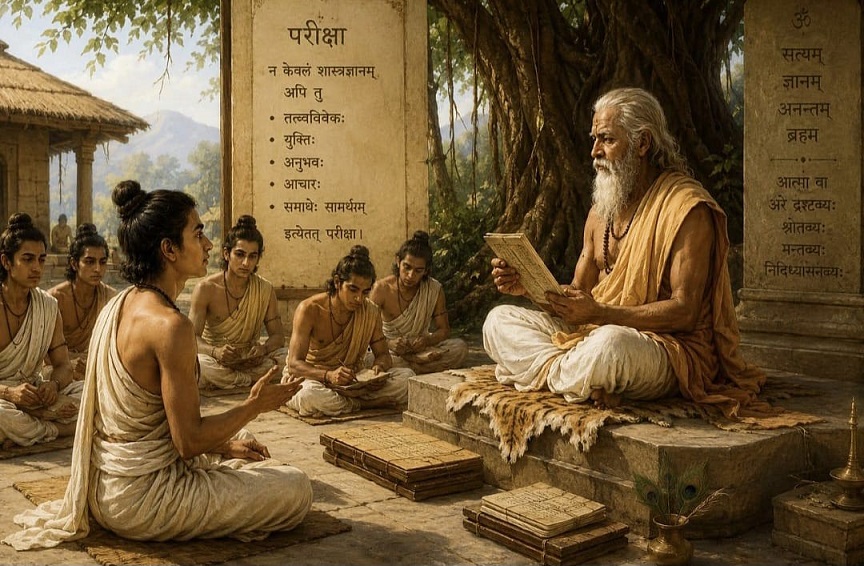
When viewed through this philosophical lens, a Parīkṣā (परीक्षा) was never limited to a standardized test evaluated by an external authority. The term broadly refers to examination, scrutiny, verification, and discernment. It implied a deeper process of testing truth, character, capability, and wisdom.
Ancient Indian education was not primarily structured around anonymous answer scripts, numerical percentages, or competitive rankings. Instead, assessment was woven into the lived experience of the learner. In the traditional Gurukula system, where students lived alongside their teacher for extended periods, the Guru observed the student’s growth through everyday interactions and experiences. The purpose was not merely to determine what a student knew, but to understand who the student was becoming.
The learner was evaluated across several dimensions:
Memory and Understanding: The ability to absorb, preserve, interpret, and communicate knowledge
Conduct and Self-Discipline: The behaviour, habits, and choices of a student beyond formal lessons
Respect for Learning: The humility, sincerity, and openness with which knowledge was received
Application of Knowledge: The transformation of information into practical wisdom and responsible action
Truthfulness and Self-Control: The alignment of thought, speech, and action
This holistic understanding of education was reflected in the Taittiriya Upanishad, where graduating students received final instructions not merely about intellectual achievement, but about life-long pursuit of truth (Satya), duty (Dharma), and righteous conduct (Sadachara).
The Battlefield of Dharma: Shreya versus Preya
One of the most profound texts of Indian philosophy, the Bhagavad Gita, begins on a battlefield — an intentional metaphor for the moral and existential struggles of human life. Arjuna’s crisis was not an examination of memory, intelligence, or technical ability. It was a deeper moral examination:
How does one perform one’s righteous duty when circumstances are painful, confusing, and emotionally overwhelming?
Human life constantly presents a choice between Shreya (श्रेय) and Preya (प्रेय).
Shreya represents what is ultimately beneficial, noble, and aligned with higher values. Preya represents what is immediately pleasant, convenient, and attractive. The challenge of life is that these two choices appear identical in certain situations. The easier path may provide immediate satisfaction, while the right path may demand sacrifice and patience.
The responsibilities of a student differ from those of a parent, a professional, a leader, or an elder. Every transition is therefore a new examination — not conducted through written papers, but through choices, relationships, responsibilities, and circumstances.
The True Passing Grade: Titiksha and Samatvam
These two foundational concepts define how an individual should approach the inevitable examinations of life: Titiksha (तितिक्षा) and Samatvam (समत्वं).
Titiksha represents patient endurance — the ability to consciously withstand challenges, discomfort, and uncertainty without losing inner stability. It is not passive acceptance or helpless suffering; rather, it is the strength to remain composed while continuing to act with clarity and purpose.
Samatvam represents equanimity — maintaining an evenness of mind amid the changing circumstances of life. Success and failure, praise and criticism, pleasure and pain are all temporary experiences. The truly evolved individual learns not to be completely controlled by these external fluctuations.
In the school of life, the highest grade is achieved not by the person who never encounters failure, but by the person who can face both extraordinary success and profound disappointment with the same clarity, humility, and balance.
Every circumstance becomes an opportunity for self-cultivation:
- A setback tests resilience
- Success tests humility
- Power tests integrity
- Suffering tests compassion
- Uncertainty tests wisdom
The purpose of these examinations is not to prove our worth to the world, but to refine our own character.
The Four Tests of Excellence
A comprehensive understanding of human evaluation is expressed in a timeless verse attributed to Chanakya Neeti.
यथा चतुर्भिः कनकं परीक्ष्यते निघर्षणच्छेदनतापताडनैः।
तथा चतुर्भिः पुरुषः परीक्ष्यते त्यागेन शीलेन गुणेन कर्मणा ॥
“As gold is tested in four ways — by rubbing, cutting, heating, and hammering — so a person is tested through four measures: sacrifice, character, virtues, and actions.”
Gold cannot reveal its purity merely through external appearance. It must pass through friction, pressure, and intense heat. Similarly, the true worth of a human being is not revealed through appearance, reputation, qualifications, or achievements alone. It emerges through the way one responds to life’s challenges.
The Examined Life
The ancient idea of Parīkṣā was infinitely broader than the narrow academic framework through which examinations are understood today.
It involved:
- Testing truth before accepting it blindly
- Testing character before placing trust in someone
- Testing relationships before depending upon them
- Testing wisdom before celebrating knowledge
- Testing oneself through the daily friction of life
An examined life is quieter, deeper, and far more demanding than the endless race for external recognition. The challenges we encounter are not punishments designed to defeat us. They are opportunities for inner transformation. Every difficulty carries the possibility of growth; every challenge provides an invitation to refine ourselves.
The ultimate purpose of examination is therefore not simply success in the eyes of the world. It is the gradual creation of a human being who is anchored in wisdom, disciplined in action, compassionate in conduct, and peaceful within.
And perhaps the final result of that examination is not a certificate, a rank, or a reward — but the quiet realization of having become a better version of ourselves.
(This article is the first part of a three part series)