
Dr Manoj Dash, Bhubaneswar, 1 October 2026
On the same street in a city, two elders wake up to the same morning sun. One stretches, steps out for a walk, calls a grandchild on video, and waits for the pension credit that arrives like clockwork. The other struggles to rise from a charpoy, counts the coins for tea, and wonders who will carry water from the tap today. Same age, same city—entirely different worlds.
The International Day of Older Persons invites us to reflect on ageing. But too often, our responses flatten this diversity into a single story: “the elderly” as a uniform category needing uniform solutions. In truth, older people are not a monolith. They are divided by wealth and poverty, by pension and precarity, by family and isolation, by mobility and immobility, by social confidence and quiet withdrawal. A gigantic, heterogeneous reality cannot be solved by a single law or a one-size-fits-all policy. What we need, at its core, is a shift in attitude: a society that carries care in its mind, treats older persons with dignity, and demonstrates empathy in everyday life.
The many divides among older persons
Ageing intersects with every fault line in society. Some elders age in comfort, surrounded by family, doctors, and domestic help. Others age alone, in rented rooms, with no one to notice if they miss a meal. Some remain mobile well into their eighties; others become bedridden much earlier. Some navigate smartphones with ease; others cannot correctly read a digital OTP or book a cab without humiliation. Some are socially engaged—leading community groups, mentoring younger generations; others retreat into silence, fearing they are a burden.
This diversity matters. It means that no policy framework, however well-intentioned, can capture all solutions. Pensions help, but they do not cure loneliness. Ramps help, but they do not restore respect within a family. Digital services increase efficiency, but they can also exclude those who cannot keep up. The missing piece is moral: a collective commitment to see older persons as full human beings—worthy of patience, voice, and care—regardless of their utility, productivity, or independence.
Care, dignity, and empathy as moral obligations
Philosophically, care is the recognition of personhood beyond economic contribution. Dignity is the respect for autonomy and choice—even in dependence. Empathy is the bridge between abstract rights and everyday interactions: the pause before irritation when someone moves slowly; the effort to explain a digital step without condescension; the willingness to listen to a story we have heard before, because it matters to them.
Indian ethical traditions offer gentle anchors here. Ahimsa (non-harm) reminds us that impatience and dismissal can wound as deeply as neglect. Seva (selfless service) frames care not as charity but as a moral responsibility. Vasudhaiva kutumbakam—the world as one family—invites us to extend kinship beyond bloodlines. A mature society is measured not by how it treats its most productive, but by how it honours those who can no longer “contribute” in conventional terms.
What an attitude of care looks like in everyday life
An attitude of care is not grand; it is cumulative. It lives in small, consistent acts:
- In families: Include elders in decisions about money, health, and living arrangements. Ask their preferences, not just their needs. Do not equate dependence with irrelevance. A simple “What do you think?” can restore agency.
- In public spaces: Offer a seat without making a spectacle. Wait patiently at counters. Do not finish sentences for someone who speaks slowly. Respect their time as you would anyone else’s.
- In institutions: Banks, hospitals, and transport systems must design processes that reduce humiliation. A separate queue is useful, but what matters more is staff trained to see the person, not just the case.
- In communities: Check on isolated neighbours. Create informal support networks—someone to accompany to the clinic, someone to read a government letter, someone to sit with for an hour. Intergenerational interactions—storytelling circles, skill-sharing, mentorship—restore purpose and belonging.
These acts are not policy; they are culture. And culture shapes how policy lands.
Three policy directions that enable a culture of care
While attitude must lead, policy can enable. Three areas deserve attention—not as silver bullets, but as enablers of dignity:
- Bridging digital exclusion: As services go online, millions of older persons risk being locked out. Policy should mandate “assisted digital access” in every public-facing office: a trained helper, a physical counter, and simple, large-font interfaces. Digital literacy programmes for elders must be community-led, not app-driven—focused on real tasks (reading a pension slip, booking a token, video-calling family) rather than abstract skills.
- Renewing intergenerational contracts: Families remain the primary safety net, but urbanization and migration strain this. Policy can support, not replace, family care: tax incentives for co-residence or nearby housing, respite care for caregivers, and community day centres that reduce isolation without institutionalizing elders. Schools and colleges can embed intergenerational service—students spending time with elders, documenting oral histories, learning practical care—as part of curricula. This rebuilds the social contract across ages.
- Designing cities for ageing bodies: Urban design is often blind to frailty. Policy must require age-friendly standards: continuous, obstacle-free footpaths; adequate seating and shade; accessible public toilets; low-floor buses with priority seating; clear signage with large fonts. These are not “elderly amenities”; they are civic basics that benefit parents with strollers, persons with disabilities, and anyone carrying a load. A city that works for its oldest is a city that works for all.
A cultural shift, not just a policy fix
None of this works without a deeper shift: from seeing older persons as problems to be managed, to seeing them as people to be treated with empathy. This begins with language. We must stop speaking of elders as “burdens,” “dependents,” or “vulnerable groups” in ways that strip agency. Instead, we speak of experience, memory, and continuity. We ask, “What do you need?” and “What can you still do?”—not “What can we do to you?”
It also begins with self-reflection. Each of us will age. The impatience we show today is the impatience we will receive tomorrow. The dignity we deny is the dignity we will crave. Empathy is not altruism; it is self-interest with a longer time horizon.
A personal pledge
On this International Day of Older Persons, consider a simple pledge: I will treat every older person I encounter with dignity, patience, and empathy. Not as a curated algorithm, but as a default setting. Not because policy requires it, but because it is what makes us human.
When care becomes our default, ageing ceases to be a problem to be managed and becomes a stage of life to be honoured. Policies will follow, but they will land on soil already prepared by a culture that sees elders not as outliers, but as integral to the fabric of society. The many faces of ageing deserve nothing less than a society that meets them with open eyes, open hearts, and open hands.
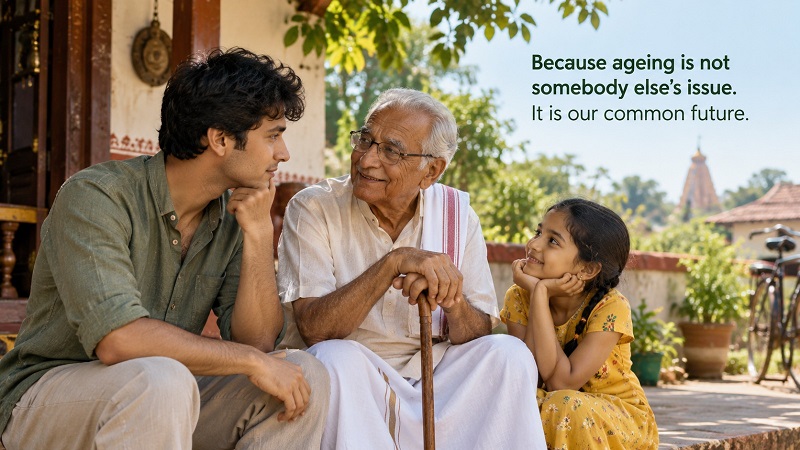
Because ageing is not somebody else’s issue. It is our common future.