
Dr Manoj Dash, Bhubaneswar, 3 November 2026
India’s economic transformation between 2014 and 2026 reveals a fundamental asymmetry in its growth model: its capacity to create and accumulate corporate wealth has expanded far more dramatically than its capacity to generate secure employment and broadly shared prosperity. As India aspires to become a developed nation and global economic power by 2047, this raises a fundamental question about the nature and distribution of its growth.
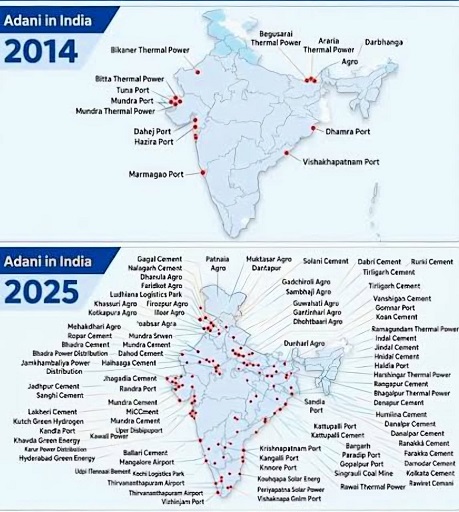
The contrasting trajectories of the Adani Group and the Aam Aadmi offer a striking illustration. Between 2014 and 2026, the Group’s market capitalisation reportedly rose from approximately $7.1 billion to $240 billion, a compound annual growth rate (CAGR) of around 34%. Over the same period, India’s nominal GDP per capita, measured in current US dollars, increased from approximately $1,554 to a projected $2,749. These are different measures and cannot be directly equated; nor does GDP per capita represent the income actually received by the average citizen. Yet the contrast captures a larger economic puzzle: why has India’s capacity to create corporate wealth not translated into comparable gains in economic security, purchasing power and employment opportunities?
The issue is not that the rise of large conglomerates has necessarily caused ordinary citizens’ economic difficulties. Rather, the policies, institutions and investment priorities enabling extraordinary corporate expansion have not created an equally effective mechanism for transmitting growth to the wider economy.
The ascent of state-aligned capital
The Adani Group’s expansion unfolded alongside a policy emphasis on rapid infrastructure creation and the development of large private corporations capable of executing projects at scale. Confronted with infrastructure deficits, the state increasingly relied on long-term concessions and private capital in sectors such as ports, airports and renewable energy. This national-champion model accelerated infrastructure development but also raised questions about market concentration, competition and the distribution of public risk and private reward.
The Group’s exposure to capital-intensive business-to-business and business-to-government sectors is significant. Its valuations are less directly dependent on ordinary households’ purchasing power than those of companies reliant on mass consumption. Access to international bond markets and institutional investors further connected its financing prospects to global capital flows. Its valuation could therefore rise even when domestic wages and household demand remained subdued.
The contrast with other Indian conglomerates is striking. During this period, the Tata Group reportedly grew at around 7.1% annually, the Aditya Birla Group at 9.4%, and Reliance Industries at 13.2% in dollar terms. The larger point is that infrastructure concessions and access to capital can generate extraordinary asset growth without a corresponding expansion in mass consumer demand. Corporate success does not necessarily signify broad-based prosperity.
Consolidation and the missing middle
The distributional consequences become clearer when we examine India’s employment structure. More than 80% of its workforce is employed in the informal sector, with micro, small and medium enterprises (MSMEs) forming a crucial part of this ecosystem. Yet many smaller businesses operate with limited access to formal credit, thin margins and little capacity to absorb economic shocks.
Demonetisation in 2016, the disruptive initial implementation of GST in 2017 and the COVID-19 lockdowns placed considerable pressure on cash-dependent businesses. Smaller enterprises, with limited reserves and weak access to credit, were particularly vulnerable. These shocks exposed a structural weakness: India could expand formal transactions and large-scale investment without building comparable resilience in its employment-generating economic base.
Meanwhile, large, well-financed corporations were better positioned to acquire assets and expand. The Adani Group’s acquisitions, including ports and the cement companies Ambuja and ACC, illustrate this consolidation. Although it would be simplistic to attribute these acquisitions directly to MSME distress, economic shocks that weaken smaller firms can create opportunities for larger players with deeper financial resources.
The missing middle is central to India’s development challenge. Large corporations can generate substantial investment and output, but without a robust ecosystem of smaller enterprises and labour-intensive industries, their expansion cannot absorb millions entering the workforce or distribute its benefits widely.
Financialisation versus household realities
The divergence is also visible in the contrasting uses of debt. While the Adani Group pursued refinancing and access to longer-term international finance, household financial savings came under pressure. According to RBI-related data, net household financial savings declined from 7.1% of GDP in 2014–15 to 5.2% in 2023–24, before recovering to a preliminary 6.0% in 2024–25.
Persistent inflation in essential goods and education, alongside uneven real-wage growth, has squeezed household budgets. Rising unsecured personal loans and microfinance borrowing have added to concerns about financial vulnerability. The distinction is important: corporations may borrow to acquire productive assets and generate future returns, whereas households often borrow for housing, education and consumption. Corporate leverage can finance long-term asset creation; household indebtedness may increasingly reflect the difficulty of sustaining living standards from current incomes.
The stagnating base: losing ground to regional peers
India’s employment challenge becomes sharper in comparison with Asian economies that used labour-intensive manufacturing to absorb workers moving out of agriculture. Bangladesh expanded garment exports and manufacturing employment; Vietnam benefited from integration into global supply chains, including the China Plus One shift; and China built a vast manufacturing base before moving up the technology ladder.
IMF October 2026 projections put Bangladesh’s nominal GDP per capita at approximately $2,886, compared with India’s $2,749, suggesting that Bangladesh may narrowly overtake India on this measure in 2026. These current-dollar comparisons are sensitive to exchange-rate movements and should not be mistaken for direct measures of household living standards.
India’s manufacturing share has remained around 15% to 17% of GDP. Its globally competitive IT sector and expanding infrastructure have generated considerable wealth, but neither employs workers at the scale required to absorb millions entering the labour market. High-productivity enclaves can coexist with widespread underemployment when education, skills and industrial demand fail to connect. The challenge is not simply generating growth, but translating it into productive employment.
The barbell economy and taxation
Fiscal policy has reinforced this uneven pattern. The 2019 reduction in corporate tax rates was intended to strengthen corporate balance sheets and encourage investment. Yet the expected gains in private investment and employment have not, by themselves, resolved the jobs challenge. Meanwhile, indirect taxes, including GST and excise duties on fuel, can weigh disproportionately on lower- and middle-income households, which spend a larger share of their income on consumption.
The state has also expanded what is described as “new welfarism”. Digital public infrastructure has enabled the delivery of free food rations to around 800 million people, farmer transfers and subsidised housing. These programmes provide an important safety net and help prevent extreme deprivation. However, welfare transfers cannot substitute for secure employment, rising wages and accessible public services. A safety net can prevent people from falling further; it cannot, on its own, create pathways for upward mobility.
Physical infrastructure over human capital
The period has brought visible advances in physical infrastructure: airports, expressways, ports and renewable-energy projects. These can reduce logistics costs, improve connectivity and support future industrial growth. Large corporations can mobilise the capital and technical capacity needed for projects of this scale.
But physical capital is only one dimension of development. A $30 trillion economy also requires sustained investment in education, healthcare and skills. Modern ports and data centres may be essential to productivity, but they do not necessarily generate large numbers of direct jobs. India’s demographic dividend depends not merely on the number of people entering the workforce, but on whether they can find productive and adequately remunerated employment.
The superpower paradox
India’s growth strategy appears to assume that world-class infrastructure, built with the help of national champions, will eventually lower costs, attract manufacturing and spread prosperity. That pathway is possible, but not automatic. Its success depends on competition, a healthy ecosystem of smaller firms, labour-intensive job creation and investment in human capabilities. Without these conditions, infrastructure-led growth may expand productive capacity while leaving the distribution of its gains narrow.
The central paradox is therefore not the extraordinary rise of conglomerates such as Adani, but the failure to build an equally dynamic foundation of productive employment, viable small enterprises and widespread household prosperity. India has demonstrated that it can mobilise capital, create infrastructure and generate corporate wealth at remarkable speed. What remains unproven is its ability to translate these achievements into comparable gains for the millions who constitute its workforce and domestic market.
The ambition of Viksit Bharat cannot be measured simply by the size of the economy, the scale of its infrastructure or the global standing of its corporations. It must also be measured by the quality of employment, household purchasing power and opportunities available to ordinary citizens. Reviving MSMEs, widening access to decent work, strengthening human capital and ensuring fair competition are essential to making growth genuinely broad-based.
A country may acquire the physical infrastructure and corporate valuations associated with a superpower. Becoming a developed economy, however, requires something more fundamental: widespread prosperity that enables its citizens to participate in, and benefit from, its economic transformation.