The Nirvik Bureau, Bhubaneswar, 21 October 2026
An imagined dispatch from the Republic of Shareholder Value.
The Capital Has Moved. Please Update Your Portfolio.
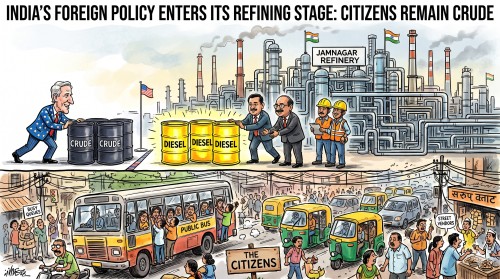
The government has clarified that New Delhi remains India’s capital. Jamnagar is merely where the capital lives.
The distinction is essential. Delhi produces statements expressing deep concern. Jamnagar produces things people actually buy. Naturally, when an American secretary of state wishes to understand India’s strategic priorities, he must visit somewhere with demonstrable output.
In this imagined diplomatic breakthrough, Marco Rubio arrives at the refinery to discover that international relations can indeed be simplified: pour complicated geopolitics into one end, extract mutually beneficial announcements from the other.
A senior official explains that this is sovereignty, now available in a business-friendly format.
One Nation, One Very Important Customer
For decades, Indians mistakenly believed foreign policy involved ambassadors, treaties and national interests. Experts now explain that national interests were always important; they simply needed a sufficiently large corporate office to host them.
“What is good for the company is good for India,” announces a policy specialist, carefully avoiding the dangerous reverse proposition.
The ordinary Indian is delighted to learn that his country has growing leverage in Washington. He asks whether this might improve his wages.
Officials praise his question as an excellent example of why economic diplomacy should remain with experts.
He is subsequently included in the joint statement as “human potential”.
Sanctions: Terms and Conditions Apply
The refinery tour includes a demonstration of the International Rules-Based Order.
First, Russian oil is morally unacceptable. Then it is economically unavoidable. Iranian oil is prohibited until circumstances permit. Venezuelan oil undergoes whatever ethical transformation the latest arrangement requires.
Delegates admire the plant’s ability to process different grades of crude.
But the greater technological achievement is processing contradictory American positions without damaging the machinery.
“Our system can handle exceptionally heavy hypocrisy,” says an imaginary engineer. “Although abrupt policy reversals do increase maintenance costs.”
A diplomat asks whether principles can also be refined.
“Certainly,” replies the engineer. “But the yield is negligible.”
The Citizen: A Valuable Renewable Resource
At the ceremonial dinner, guests discuss investment, energy security and the importance of resilient partnerships.
Outside, a citizen wonders whether “energy security” includes being able to afford cooking gas.
Security personnel explain that he has misunderstood the programme. The discussion concerns energy security at the strategic level, where household expenses look much smaller.
He is invited to appreciate the bigger picture from behind a barricade.
Inside, a presentation celebrates India’s demographic dividend. Nobody asks the dividend whether it has eaten.
Please Hold. Your Nation Is Important to Us.
The visit concludes with broad agreement that governments and corporations must work together.
Government will provide legitimacy, infrastructure and the occasional inspiring speech. Business will provide scale, access and a venue with reliable air-conditioning.
The public will provide the mandate, then wait outside while it is put to productive use.
A proposed diplomatic protocol replaces the red carpet with a conveyor belt: ministers step on in Delhi and emerge in Jamnagar carrying investment brochures.
The foreign ministry denies it is becoming a corporate help desk.
“Absolutely not,” says its spokesperson. “A help desk answers to customers.”
He pauses.
“We prefer the term strategic partnership.”