The Nirvik Bureau, Bhubaneswar, 10 October 2026
Democracy: A Family Business with Public Liability
At the Emergency Conference on Political Change, the first item on the agenda was whether change could be postponed until everyone’s children had been suitably accommodated.
The opposition arrived carrying its greatest contribution to democracy: surnames.
“We must reconnect with ordinary Indians,” announced a hereditary leader, settling into a chair that had also served his father and was being assessed for succession by his nephew.
A consultant suggested meeting voters.
There was an uncomfortable silence. Someone asked whether voters could instead submit their grievances through the family office.
The gathering eventually agreed on a radical programme: a group photograph. Everyone stood shoulder to shoulder, demonstrating that ideological differences could always be overcome by the prospect of losing government accommodation.
Cleanliness Begins Where the Camera Is
Across town, the ruling party was preparing another spontaneous demonstration of service.
A minister arrived at a spotless pavement with a broom, twelve photographers and sufficient security to prevent any actual dirt from approaching him.
Unfortunately, the location was too clean even for ceremonial sweeping.
An official was dispatched to procure rubbish.
“Not that rubbish,” the minister instructed. “Something dignified. Dry leaves. No municipal reality.”
After seventeen takes, the minister successfully moved three leaves from one side of the pavement to the other.
The resulting video was captioned: “A Nation Transformed.”
The leaves declined to comment.
Nearby, a clogged drain continued its anti-national refusal to improve.
Development: Now Available in High Definition
At the Ministry of Visible Progress, officials unveiled a magnificent new hospital.
It had excellent lighting, a sweeping aerial shot and an inspirational soundtrack.
“Does it have doctors?” asked a journalist.
“It has reach,” replied the spokesperson.
A school was similarly upgraded from a leaking building to a compelling campaign graphic. Its pupils still lacked desks, but the minister’s portrait had acquired remarkable resolution.
The government explained that development must first enter people’s imagination.
Their stomachs, classrooms and sewage systems would be considered in the next phase.
Meanwhile, advertisements urged citizens to celebrate the highway beneath the chief minister’s smiling face. Citizens living beside potholes were advised to appreciate the larger picture.
Preferably on television.
The Cockroaches Refuse the Seating Plan
Then came the political inconvenience nobody had budgeted for: young people who wanted functioning institutions rather than commemorative hashtags.
They walked through streets, spoke to strangers and asked questions without first obtaining a television studio.
Established politicians were horrified.
“You cannot simply mingle with the public,” one protested. “There are procedures. Barricades. Invitations. Approved beneficiaries.”
Veteran operators immediately offered to guide the movement, preferably from its front row.
The newcomers were warned that politics was complicated.
Apparently, demanding a decent school was simplistic; explaining for twenty years why it remained indecent required statesmanship.
Please Update Your Leadership
Finally, the establishment discovered Gen Z.
Senior leaders rehearsed youthful gestures while advisers translated unemployment into engagement metrics.
“Perhaps say ‘vibe’,” suggested one.
“But what is our vibe?”
“Continuity, sir.”
Outside, voters were asking for change.
Inside, the printer was already working.
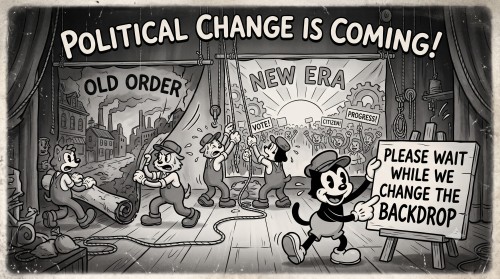
New slogans. New banners. New colours.
The same gentlemen requested that nobody touch their chairs.