The Nirvik Bureau, Bhubaneswar, 23 August 2026
A centenary, a courtroom, and two reports that apparently took voluntary retirement
Odisha has discovered a new and highly efficient model of governance: when justice gets delayed long enough, commemorate it. When evidence goes missing, inaugurate a heritage village. And when judicial reports vanish from the Chief Minister’s Office, treat the office not as an administrative headquarters but as a paranormal hotspot.
At the birth centenary of Swami Laxmanananda Saraswati, Chief Minister Mohan Charan Majhi promised that “every drop” of the slain leader’s blood would receive justice. This is an emotionally powerful assurance, especially since the files that might help identify who owes that justice have apparently been playing hide-and-seek for years.
In Odisha, even official documents now seem to possess survival instincts.
The Court Acquits, Politics Convicts
A special court acquitted Maoist leader D. Kesaba Rao, alias Azad, after finding insufficient evidence. Notably, the purported Maoist letter claiming responsibility – an item that would seem mildly useful in a murder case – was reportedly not produced before the court.
But courts, as everyone knows, are limited by tedious things such as evidence, procedure, witnesses and proof. Politics enjoys a more liberating legal framework: accusation first, investigation later, rally immediately.
Azad spent 15 years in jail before being cleared in the remaining major case against him. That is not merely a judicial delay; it is a full undergraduate degree in incarceration, with a postgraduate diploma in state inconvenience.
Still, the acquittal has produced a familiar national reflex: demand a new probe. In Indian public life, every failed investigation is lovingly followed by a demand for a superior investigation, which will eventually need an even superior investigation – until justice becomes a multilevel-marketing scheme.
The Great CMO Disappearance Act
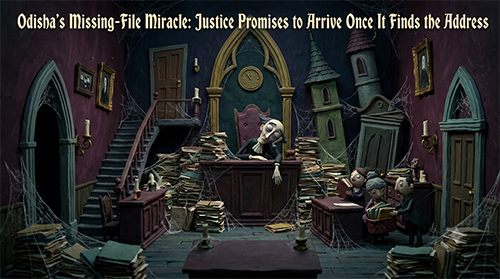
The state government says two inquiry reports cannot be found: one relating to the Laxmanananda Saraswati killing and the Kandhamal violence, and another concerning the SUM Hospital fire. The reports were submitted; they were officially important; they were presumably made of paper; and then, in a miracle that should interest both historians and magicians, they became “untraceable.”
This is the beauty of Indian bureaucracy: a citizen misplaces a birth certificate and is treated like a threat to civilisation. A government misplaces a judicial commission report on murder, riots and mass displacement, and suddenly everyone becomes a philosopher of uncertainty.
Perhaps the reports are not missing. Perhaps they are simply observing administrative silence, a practice perfected by many institutions that own cupboards but lack curiosity.
The BJP alleges deliberate concealment under the previous BJD government. The BJD responds by asking why the BJP, after two years in office, only now noticed that the reports had gone missing. This is a serious question. It takes extraordinary administrative discipline to lose a report for a decade, and even greater discipline to spend two years looking at the empty shelf before deciding to file an FIR.
Development, Devotion, and Decorative Justice
A medical college is being named after Saraswati. Funds have been announced for the ashram’s redevelopment. His village may become a heritage village. These are tangible announcements—the kind that can be photographed, garlanded and placed beneath a large flex banner.
Truth, unfortunately, is less photogenic.
The 2008 killing was followed by horrific communal violence in Kandhamal, in which lives were lost, families displaced and religious sites damaged. Yet the political argument now appears determined to turn an old wound into a campaign-stage prop: polished annually, invoked emotionally, and kept safely away from the inconvenient clutter of accountability.
Odisha does not merely need more promises that justice will come. It needs someone to check whether justice has been lodged in the same cupboard as the missing reports.
Because at this rate, the next commission may be appointed not to investigate the murder – but to investigate who stole the investigation.