The Nirvik Bureau, Bhubaneswar, 22 August 2026
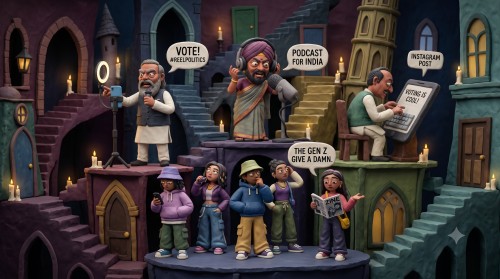
With 2029 in sight, BJP and Congress have discovered the republic’s newest constitutional authority: the 18-year-old with 4G, low battery, and an attention span shorter than a cabinet reshuffle.
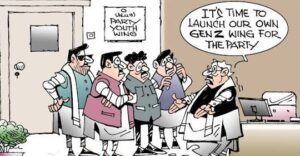
Courtesy: Threads
The Voter Who Will Not Watch a Speech
For decades, Indian politics relied on the reliable architecture of democracy: rallies, flags, loudspeakers, helicopters, barricades, and one leader speaking for 47 minutes about a future nobody could locate on Google Maps.
Then came Gen Z.
This is a voter who will not sit through a manifesto, but may absorb an entire ideological position through a 12-second reel featuring subtitles, dramatic music, three reaction emojis and a politician attempting “GRWM” – Get Ready With Me, presumably for a constitutional crisis.
The political establishment is alarmed. Not because young people are unemployed, anxious about education, paying obscene rents or wondering whether a degree is now merely a decorative PDF. No, the true emergency is that they are consuming politics on Instagram.
Naturally, both major parties have responded in the only mature manner possible: by trying to become content creators.
BJP’s Campus Tour: One Day, One University, Infinite Selfies
The BJP has launched “One Day, One University,” under which ministers visit campuses to interact with students. It is an admirable development. After years of explaining the nation to students from television studios, the government has decided to locate actual students in the wild.
A Union minister will arrive, deliver a motivational sermon about youth power, pose beside a laboratory, shake hands with a student in an ABVP scarf, and leave before anyone asks whether the campus Wi-Fi works.
The idea is to move from one-way messaging to dialogue. Dialogue, in modern political grammar, means a student asks a question and the leader replies: “First, let me congratulate India.”
Prime Minister Narendra Modi, meanwhile, has reportedly embraced selfie-style videos and reels. This is history in motion: the statesman of “Mann Ki Baat” becoming the influencer of “Mann Ki Reel.”
Soon, every national issue may receive its own format:
- Inflation: “Five hacks to stretch your salary till the 28th!”
- Joblessness: “POV: You are India’s demographic dividend.”
- Exam leaks: “Expectation vs Reality – student edition.”
- Democracy: “Like, share and comment ‘Viksit’ for Part Two.”
The nation is not being governed. It is being optimised for engagement.
Congress Finds the Comment Section
Congress, having long mastered the art of turning a press conference into an archaeological site, has also entered the youth market. Rahul Gandhi’s “Chhatron Ki Goonj” seeks to bring student grievances into politics – an audacious proposition in a country where student grievances are normally forwarded to the relevant department, which is currently “under process.”
The new formula is “dard, data, daulat”: pain, statistics and wealth. It is considerably more promising than the old formula: pain, press release and postponement.
Congress has embraced direct Q&As with students, which is brave. Young people today ask questions without the ceremonial respect that Indian politics usually demands. They do not begin with, “Respected sir, with due regard to your visionary leadership…” They begin with: “Why though?”
And there is no official answer key for that.
India’s First Fully Filtered Election
By 2029, Gen Z may number nearly 380 million, an electoral mass large enough to influence governments, trends, app downloads and the national supply of ring lights.
But both parties appear to have misunderstood them in identical ways. They think Gen Z wants “relatable” leaders. What Gen Z may actually want is less relatability and more rent relief, credible jobs, functioning colleges, transparent exams, cleaner cities, safer public spaces and the rare public figure who can answer a question without calling it anti-national, anti-development or badly framed.
Still, hope survives.
At least now, when politics ignores young people, it will do so in portrait mode.