
The Nirvik Bureau, Bhubaneswar, 24 August 2026
Dhaka discovers the ultimate foreign-policy accessory
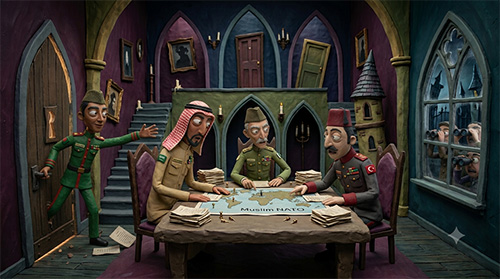
Bangladesh is reportedly considering the Mecca Joint Defence Agreement – a Saudi Arabia – Pakistan – Turkey security arrangement that some have generously nicknamed an “Islamic NATO.” The phrase is doing heroic work here: NATO has a command structure, decades of institutional machinery and a shared habit of convening emergency meetings; this new club has, so far, an acronym-shaped ambition and a collective promise that an attack on one is an attack on all – subject, presumably, to everybody first finding the right WhatsApp group.
Dhaka has not said it will join. It is merely “keeping the option open,” which in diplomatic language means: we are browsing, comparing plans and waiting to see whether the annual subscription includes energy security, defence equipment and complimentary geopolitical leverage.
The all-inclusive strategic package
The sales pitch is undeniably appealing. Saudi Arabia brings money, oil and remittances. Turkey brings drones, defence production and the confident expression of a country that has read every instruction manual upside down and still built the machine. Pakistan brings military experience and a nuclear umbrella—though, as with all umbrellas in South Asia, one hopes it is never opened indoors.
Bangladesh, meanwhile, brings a valuable strategic location, an energetic economy and the capacity to make every neighbour ask, “Why is everyone suddenly being so friendly?”
The official justification is national interest: improved defence cooperation, training, technology, investment, protection of shipping routes, energy supplies and trade. In other words, the pact is not about religion, alignment or sending coded messages to India and China. It is simply a modest scheme to ensure that Bangladesh can have better weapons, safer sea lanes, larger investments, uninterrupted oil, happier expatriate workers and perhaps a few powerful friends who return calls.
This is called “strategic autonomy” – the art of sitting in several boats simultaneously and insisting that the water is perfectly calm.
Mutual defence, mutual confusion
The agreement’s core idea is collective defence: attack one member, and the others treat it as an attack on all. It sounds reassuring until one imagines the first crisis meeting.
Saudi Arabia asks whether the oil market has been consulted. Turkey proposes a drone demonstration. Pakistan asks whether there is a security dimension. Bangladesh politely requests that everyone first clarify whether this is a military alliance, an economic partnership, a diplomatic mood board or merely a very expensive group photograph.
Still, the “Islamic NATO” label has real advantages. It instantly supplies grandeur, seriousness and a mild shiver in every foreign ministry from New Delhi to Washington. Never mind that the pact lacks NATO’s integrated command system. A regional alliance without operational details is not a flaw – it is an opportunity for each member to interpret “collective defence” in the most nationally convenient way possible.
Neighbours check their binoculars
India is understandably watching. Bangladesh’s warming contact with Pakistan, Saudi Arabia and Turkey arrives while Dhaka–New Delhi relations remain uneven. India says it is “closely following developments,” the diplomatic equivalent of someone staring intensely at the neighbour’s new car while claiming to be uninterested.
Yet Bangladesh is not necessarily abandoning one camp for another. It is collecting options: China for engagement, Saudi Arabia for remittances and capital, Turkey for defence ties, Pakistan for renewed connectivity, and India for the geographical inconvenience of being impossible to ignore.
That is the modern diplomatic doctrine: never put all your eggs in one basket; distribute them across several rival baskets, smile at each owner and pray nobody starts counting.
For now, Dhaka has not joined anything. But in a region where uncertainty is the only truly integrated institution, even window-shopping for alliances can make the neighbourhood nervous.