The Nirvik Bureau, Bhubaneswar, 6 July 2026
Platform pauses film “in light of current developments”; democracy, human dignity and historical facts advised to hold for further investigation.
They told us cinema makes history live. They did not warn us that history might need a parental advisory, a committee, and a software update before it can be allowed to breathe.
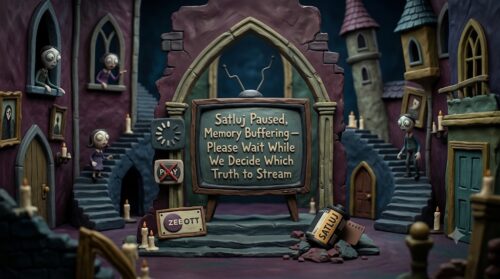
Enter Satluj: once a river of memory, now an app notification. The Diljit-starrer arrived like any respectable cultural artifact – with a director’s courage, a producer’s spreadsheet, and an activist’s bruised ledger of unclaimed bodies. And like all good inconvenient things in our age, it was given the digital treatment: uploaded, licensed, curated, then politely asked to go away until “due process” could be established. The message read like an elegy for accountability: temporarily unavailable in India “in light of current developments.” Translation: please wait while we consult our lawyers, our advertisers, and that part of the state that prefers memories on airplane mode.
Politicians were quick to detect the faint scent of drama – Sukhbir Singh Badal called it an assault on collective memory, which is telling, because collective memory apparently comes in two flavors: the one everyone remembers and the one someone decides is better forgotten. The timing was impeccable: Punjab is prepping for elections, emotions are on the electoral menu, and a film about lost sons threatens to be more than cinema – it risks being a conversation. That is the industry’s real sin these days: giving people something to talk about that hasn’t been approved in triplicate.
What does a film do that a court cannot? It dresses dry documentation in the theatrical habit — gives the Cremation Register a face, a voice, a soundtrack. For a generation raised on headlines and highlight reels, Satluj could convert judicial findings into public memory. That is inconvenient because memories are contagious; once people catch them, they start asking awkward questions like “Who killed them?” and “Why weren’t families told?” – questions that are poor matches for message-control strategies.
The curious thing about disappearance is that it always comes with a return policy. Khalra himself – whose tireless counting of cremations read like an audit of shame – was taken away, and the state later handed his story over to the courts. The courts returned convictions, the archives kept the files, and the public? The public got busy. Then a film shows up and the public becomes alarmingly interested again. So the platform hits pause, which is the cultural equivalent of covering your ears and humming until the noise stops.
Satluj’s suspension follows a classic script: create controversy by creating truth; manage fallout by calling for “due process”; watch outrage migrate from screens to TV panels and back to social media where truth circulates at no subscription fee. In the process, the film’s disappearance becomes the film’s best plot twist. The river that once carried testimony now carries hashtags and sound bites. The more you try to dam a story, the more it becomes hydrology of dissent — floods of opinion, deltas of dismay.
And of course, there are heroes and ghosts in this minnows-and-myths ecosystem. Khalra’s question – if unclaimed bodies had names, who had the authority to bury both the corpses and the questions about them? – outlives all the press releases. Platforms can pause, committees can deliberate, and politicians can posture. But you cannot put a censor’s pause on a memory that has already been delivered into someone’s mind.
Final scene: Satluj, streaming icon with a white dot that never quite ticks to play, waiting in perpetuity. Meanwhile, in living rooms and tea stalls, the story rewinds itself – without a permit. The film might be paused, but the question Khalra asked is on continuous loop: who decides what may be erased, and how long will we download our history in fragments until we remember to check the recycle bin?