
The Nirvik Bureau, Bhubaneswar, 13 August 2026
After N. Chandrasekaran’s exit reportedly followed one insufficiently unanimous vote, the group reassures investors that its governance machine remains fully operational—provided nobody asks who is operating it.
The Boardroom Has Spoken. Apparently.
In a development that has startled corporate India, Tata Sons chairman N. Chandrasekaran has departed after a decade at the helm, reportedly because a board vote failed the ancient Indian corporate test of unanimity, purity and adequate reverence.
Ordinary companies may consider a majority vote a victory. But Tata Sons, being no ordinary company, appears to have adopted a more spiritual management model: one dissenting eyebrow can halt a succession plan.
The message is wonderfully clear. At the nation’s most admired conglomerate, everyone is empowered to make decisions – right up to the exact moment that someone more empowered decides otherwise.
Chandrasekaran, we are told, did not want an extended term without full consensus. This is admirable. In modern India, where coalition governments, family WhatsApp groups and apartment associations run on permanent disagreement, Tata has discovered the corporate equivalent of enlightenment: nobody moves until everybody feels exactly the same thing.
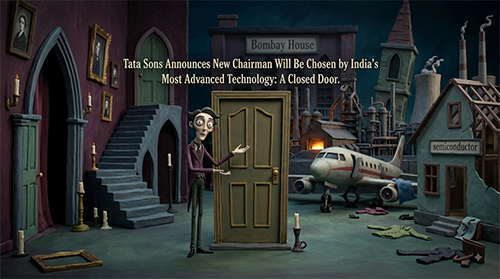
Naturally, this may delay a few minor matters, such as running airlines, building semiconductor plants, making electric-vehicle batteries, restructuring digital businesses and allocating billions of dollars. But principles are principles. A chip fabrication facility can wait. Consensus cannot be rushed.
Welcome to the Conglomerate of Many Steering Wheels
The episode has revived the timeless question: who exactly holds power at Tata Sons?
The answer, as always in elite institutions, is both “everyone” and “please do not be silly.”
There is the chairman. There is the board. There are the trusts. There are committees. There are advisers. There may be a ceremonial filing cabinet with decisive opinions. In theory, this is called institutional governance. In practice, it resembles an Indian wedding buffet: vast, prestigious, impeccably arranged, and impossible to tell who is actually serving what.
The Tata Trusts, which hold decisive ownership influence, naturally occupy a position of lofty detachment. They do not run the business, one imagines. They merely possess the philosophical ability to determine which business-runner is sufficiently run-worthy.
This is not interference. It is what management textbooks call “strategic gravitational presence.”
An incoming chairman, therefore, will need exceptional leadership qualities: vision, discipline, global credibility, operational expertise, emotional resilience and the ability to read a room whose real decisions may have been made in another room.
Air India, Chips and the Search for Certainty
The timing is exquisite. Air India is still trying to convince passengers that “on time” is not merely a poetic concept. Tata’s semiconductor ambitions require enormous patience, capital and international confidence. Its clean-energy and EV bets demand years of uninterrupted planning.
So, naturally, this is the perfect moment to remind everyone that the top job can be subject to a constitutional weather system known as “one vote went differently.”
Markets are expected to react with the calm confidence usually displayed by passengers when an airline captain announces, “We have a small technical issue, but our board is unanimously discussing it.”
The next chairman may be a Tata veteran, an external star, or perhaps a quantum physicist capable of being simultaneously independent, obedient, visionary and unanimously approved.
Until then, the group’s central question remains elegantly unresolved: is Tata Sons run by executives, trustees, boards – or by the sacred Indian principle that real power must never be so obvious as to become accountable?
That uncertainty, fortunately, is one tradition nobody seems eager to disrupt. The reported resignation and the governance questions it raises come as Tata pursues high-stakes plans across aviation, semiconductors, clean energy, mobility and digital businesses.