The Nirvik Bureau, Bhubaneswar, 9 September 2026
When breakfast discovers it has a commodity portfolio
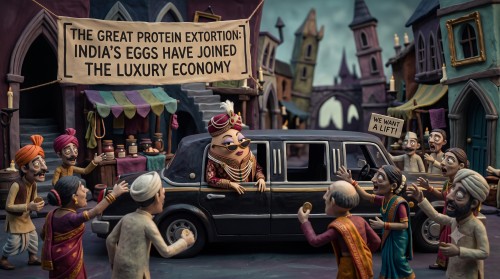
India’s humble egg, once the democratic oval of nutrition, is now behaving like an investment banker: expensive, temperamental and apparently dependent on global market signals, climate anxiety and a maize crop having an existential crisis.
At Rs 7 – 9 apiece in retail markets, the egg has finally achieved what successive governments, nutritionists and school meal schemes could not: it has made ordinary citizens pause before asking, “Ek anda dena.”
Soon, households may need to consult a financial adviser.
“Should we have an omelette today?”
“No, dear. The market is volatile. Let us wait for soymeal futures to stabilise.”
The chicken, meanwhile, would like everyone to know that it did not demand this lifestyle. It merely asked for maize, protein, minerals, vitamins, fat, amino acids and a reasonably survivable climate. Instead, it has been drafted into the world’s most complicated supply chain: a winged agricultural start-up powered by corn, oilcake, El Niño, ethanol policy and human greed.
Maize: The grain that wants to be petrol
The central villain in this poultry thriller is maize – the dependable carbohydrate that keeps chickens alive, cattle productive and bureaucrats excited about fuel blending targets.
A chicken sees maize and thinks, “Lunch.”
A government planner sees maize and thinks, “Twenty percent ethanol blending.”
A consumer sees maize and eventually thinks, “Why is my egg priced like a small cryptocurrency?”
This is the beauty of modern policymaking: the same grain must feed animals, support farmers, stabilise food prices, reduce oil imports, power vehicles and possibly help the nation achieve moral greatness. Naturally, it cannot do all of that without becoming expensive.
The chicken is expected to understand national priorities. It must now choose between becoming an omelette or becoming a subsidy-adjusted molecule in a petrol tank.
The cow, as usual, has received no official briefing.
Soymeal plays ping-pong, consumers play hunger games
Soymeal prices rose spectacularly, then eased somewhat, which should have been good news except maize promptly decided it was its turn to panic. Feed manufacturers describe this as a “ping-pong game.” Farmers describe it more accurately as being hit repeatedly in the face by an invisible racket.
Layer feed has climbed from roughly Rs 24 – 26 to Rs 30 – 32 a kilogram. Broiler feed has moved upward too. Since feed forms 65 – 70% of egg-production costs, the egg farmer has limited options:
- Raise prices.
- Absorb losses.
- Teach hens the benefits of intermittent fasting.
- Request them to lay only on days when commodity markets are calm.
The hens, experts say, remain uncooperative.
They are also suffering from heat stress, water shortages and higher mortality – conditions that, coincidentally, have become familiar to most humans buying groceries.
Festival relief: The nation’s accidental price-control mechanism
Every year, there is a brief period when egg prices soften because many households avoid eggs during Shravan, Pitru Paksha, Navratri, Diwali and Chhath. This is perhaps India’s most elaborate food-price management system: religious calendars doing what commodity policy cannot.
For a few weeks, poultry farmers watch demand retreat; consumers enjoy a temporary reduction; and eggs sit quietly wondering why they have become culturally controversial but economically indispensable.
Then winter arrives, demand returns, and every household rediscovers that protein is important – preferably after the price has already risen.
The annual cycle is reassuring. India may not always predict the monsoon, soybean output or ethanol diversion, but it can reliably predict that everyone will be shocked when eggs cost more after the period in which fewer people bought them.
Coming soon: Milk by instalment, chicken on EMI
Milk is next in the queue, because cattle feed too depends heavily on oilseed meals, rice bran and maize. When the cost of feeding animals rises, the animal does not attend a press conference. It merely produces costlier milk, meat or eggs while economists explain that this is “pass-through.”
Consumers know it by another name: “Why is breakfast now a premium experience?”
Soon, milk packets may carry disclosures:
Contains calcium, protein and indirect exposure to international agricultural volatility.
Chicken shops may introduce dynamic pricing:
“Today’s broiler rate is linked to humidity, maize acreage, soybean imports, El Niño conditions and whether the government considers grain more useful in a hen or a hatchback.”
India’s protein revolution is clearly progressing. Livestock output is steadily becoming as economically important as crops. The only minor complication is that the livestock must eat crops before humans can afford to eat livestock products.
That is not a crisis. It is merely the market reminding us that in a country where grain can become fuel, breakfast is no longer food.
It is energy policy with a yolk.