The Nirvik Bureau, Bhubaneswar, 1 September 2026
Eight years, sixty hearings, countless adjournments – and still the river has received less direction than the tribunal’s catering invoices.
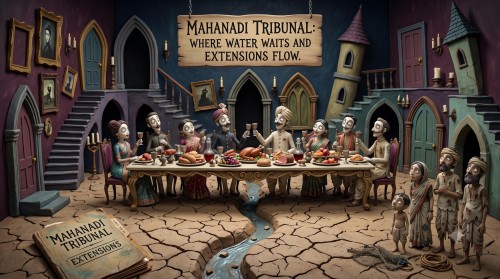
The Mahanadi is a river, which is unfortunate. Had it been a government file, it might at least have moved from one desk to another. Instead, it flows – sometimes reluctantly – through Chhattisgarh and Odisha, while a magnificent constitutional aquarium called the Mahanadi Water Disputes Tribunal watches the water problem evolve into a paperwork ecosystem.
The tribunal was created after negotiations failed. This was sensible: when people cannot settle a matter through discussion, appoint judges, lawyers, committees, affidavits, technical experts and several thousand pages of documents. Nothing accelerates a water dispute like turning it into a legal monsoon.
Eight years later, the tribunal has reportedly conducted nearly sixty hearings and around twenty technical meetings. This is an impressive achievement if the intended outcome was to prove that water evaporates more quickly than institutional urgency.
The Art of Not Deciding
The dispute itself is hardly decorative. Odisha says industrial barrages upstream in Chhattisgarh reduce lean-season flows, hurting farmers, fisheries, sediment movement, the delta and freshwater aquifers. Chhattisgarh says the structures harvest rainwater and recharge groundwater. Both positions demand investigation, data and a decision.
But decisive action, regrettably, is a substance more scarce than lean-season Mahanadi water.
Over the years, the parties have perfected a choreography of administrative delay. First came claims. Then counterclaims. Then corrections to counterclaims. Then typographical corrections to corrections. Then appendices. Then replacements of appendices. Then perhaps an appendix explaining why the original appendix was psychologically unprepared for tribunal life.
A witness eventually appeared. This was treated as an alarming development. Counsel needed time to seek instructions. Then more time. Then the principal lawyer was unavailable. Apparently, the several other lawyers attending proceedings had travelled not as advocates but as a delegation of ornamental confidence.
In ordinary life, if a plumber takes eight years to inspect a leaking pipe, one calls him incompetent. In public life, one grants him an extension.
Negotiations: The Solution That Failed Before It Succeeded
The tribunal was established because Union-facilitated negotiations had failed. Now, after years of tribunal proceedings, the tribunal itself has again urged the Union government and the Central Water Commission to facilitate negotiations.
This is not circular reasoning. It is circular irrigation.
Odisha’s leadership has repeatedly announced that a settlement is just around the corner – within three months, within two months, by Deepawali, shortly, very shortly, and presumably as soon as the calendar finds a politically convenient season. Chhattisgarh, meanwhile, has welcomed proposals with the elegant caution of someone who owns the upstream tap.
The public is invited to celebrate the revival of “amicable settlement,” a phrase that here means everyone agrees the dispute should end, provided nobody has to surrender water, revise industrial commitments, produce inconvenient data or accept a binding award.
A tribunal that cannot issue an effective award but can repeatedly recommend fresh talks resembles a traffic police officer who, after eight years at a jammed crossing, suggests motorists “consider moving forward harmoniously.”
Inspection Tourism, With Hydrology
The tribunal has also shown that justice is not merely blind; it travels comfortably.
A five-day visit to Odisha in 2026 reportedly cost Rs 2.41 crore. The Hirakud Dam segment alone allegedly accounted for Rs 1.46 crore, including hotel accommodation, travel and event-management expenses. Earlier visits reportedly involved crores more for tents, logistics, transportation, food and lodging.
One must admire the ambition. The Mahanadi may be water-stressed, but the inspection economy appears magnificently hydrated.
For this money, citizens might reasonably expect a map, a formula, a binding allocation, a deadline or at least a conclusion. Instead, they receive the ceremonial movement of officials from Delhi to riverbank and back again—like a touring production of Waiting for Godot, except Godot is a water-sharing award and the audience is paying for the tents.
The Only Thing That Flows
The tribunal’s continued existence serves a curious purpose. Lawyers remain employed, officials remain mobile, meeting rooms remain booked, governments retain talking points and press conferences retain their seasonal crop of deadlines.
Only the downstream population remains asked to wait.
The Mahanadi dispute does not need another extension, another assurance or another “last chance.” It needs a binding, transparent determination based on hydrological evidence and enforceable allocations – or an honest admission that the tribunal has become a public-funded waiting room.
Until then, the river will continue to teach India’s institutions a cruel lesson: when governments cannot share water, they generously share postponements.