The Nirvik Bureau, Bhubaneswar, 30 August 2026
In the country’s newest financial wellness programme, creditors discover that “resolution” means resolving to forget arithmetic.
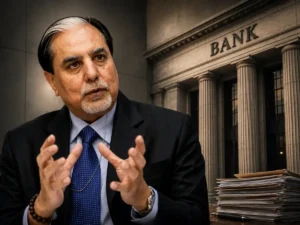
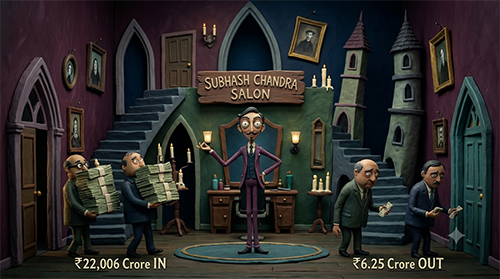
Mumbai’s insolvency ecosystem has reportedly achieved a landmark breakthrough: the conversion of approximately ₹22,006.57 crore in admitted creditor claims into a repayment plan worth ₹6.25 crore – plus ₹25 lakh for the paperwork, because even miracles need stationery.
The National Company Law Tribunal approved the plan after a commanding 80.814% of creditors voted in favour. Banks objected, naturally, with their quaint old-fashioned attachment to such concepts as “money lent,” “money owed,” and “money returned.” But they collectively held only 19.186% of the vote, proving once again that in modern finance, democracy is not about one person, one vote. It is about one debt, one very strategically positioned vote.
The Mathematics of Faith
When ₹22,006 crore becomes ₹6.25 crore, it is not a haircut. It is a full-body tonsure with complimentary shampoo.
The banks had apparently entered the insolvency process expecting recovery. This was their first mistake.
They should have arrived with a spiritual outlook, a yoga mat, and a willingness to embrace detachment. After all, what is ₹22,006 crore? A mere illusion. A material attachment. A number created by accountants to distract us from life’s larger truth: if enough creditors agree that a mountain is a molehill, then the mountain must respectfully shrink.
The repayment plan offers lenders roughly the financial equivalent of finding a two-rupee coin beneath the sofa after losing the house.
And yet, the process has been called a resolution. Which is technically correct. The debt has indeed been resolved – not in the sense of being paid, but in the sense that everyone has been instructed to stop discussing it.
Meet the Majority: Democracy’s Preferred Creditors
Banks brought loans. Others brought voting power. Guess which one the system found more useful.
At the heart of the matter are claims that several entities backing the plan may be associates or related parties of the personal guarantor. Banks have alleged that at least five such entities, holding 61.78% of the votes cast, supported the proposal.
The office of Subhash Chandra has denied those allegations, saying the entities do not qualify as associates under the Insolvency and Bankruptcy Code, and that some business interests had been separated through a family business arrangement long ago.
This is where Indian corporate jurisprudence becomes a family drama with better legal billing.
In ordinary families, relatives come over for weddings, funerals, and unsolicited advice. In corporate families, the question is more sophisticated: “Are you related enough to attend the creditor meeting, but unrelated enough to vote?”
It is an exquisite legal dance. A brother may be a brother at Raksha Bandhan, but not necessarily an associate at a voting table. A sister-in-law may be family at dinner, but perhaps a distant constellation in the compliance universe. It all depends on whether the relationship is examined through sentiment, shareholding, control, disclosure, or a sufficiently determined legal definition.
The 1,260 Angels of Unverified Debt
Documentation is overrated when verbal assurances can be promoted to financial instruments.
The NCLT also noted discrepancies in 1,260 individual claims admitted without adequate documentary verification. Among them were claims filed on behalf of 960 and 300 individuals, reportedly explained by the assertion that they had worked for Chandra or his establishments and had been verbally promised financial assistance.
This is an inspiring development for India’s paperwork-heavy economy.
For years, ordinary citizens have been tortured by banks for signatures, income proofs, property documents, GST returns, Aadhaar links, PAN links, photographs, and occasionally a blood sample from their great-grandparents. But now, at the higher altitudes of insolvency, a verbal assurance may apparently acquire the majestic dignity of a claim.
The lesson is simple: if you owe a bank ₹5,000, expect 47 documents. If someone claims you verbally promised them a financial future, perhaps expect a seat at the creditors’ table.
The New IBC Motto
“Maximum value for creditors” has evolved into “maximum creativity around creditors.”
The Insolvency and Bankruptcy Code was meant to bring discipline, speed and value maximisation to debt resolution. Instead, it sometimes resembles a magic show where the debt is placed in a large box, witnesses are asked not to blink, and – abracadabra – the creditors emerge holding a settlement amount small enough to frame.
Perhaps the real innovation is philosophical. The system has finally stopped pretending that creditors are there to recover money. They are there to provide atmosphere – like mourners at a very expensive funeral.
Meanwhile, ₹22,006 crore remains a useful reminder: in India, even debt can aspire to become fiction.