The Nirvik Bureau, Bhubaneswar, 16 September 2026
Centre serves millet diplomacy; states respond with fish heads, fury, and federalism
India has finally found the issue capable of replacing the tedious old quarrels over taxes, language, governors, unemployment and who gets to inaugurate a railway platform twice.
The nation’s newest constitutional crisis is lunch.
For years, India’s federal structure survived inconvenient details such as different languages, histories, cuisines, climates and civilisations. But apparently, it was never designed to withstand a plate containing both millet khichdi and mustard fish curry. The Constitution may have imagined Union, State and Concurrent Lists; it clearly forgot the far more explosive Menu List.
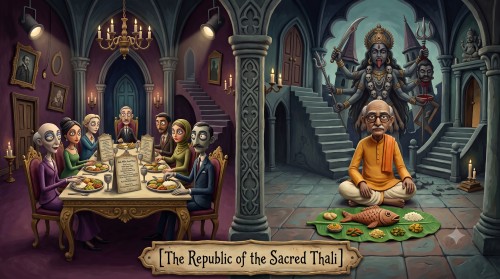
At the recent BRICS spectacle, India presented the world with the kind of meal global leaders are expected to admire, photograph and later pretend they enjoyed: an entirely vegetarian, millet-forward, wellness-certified diplomatic thali. It was not merely dinner. It was a foreign-policy document, served warm.
Every grain of millet appeared to whisper: “Ancient wisdom.”
Every bowl of lentils said: “Civilisational confidence.”
Every vegetable was arranged with the solemnity of a Cabinet reshuffle.
The message was unmistakable: India is modern, spiritual, climate-conscious, export-ready and – most importantly – photogenic without gravy stains.
No fish was invited, presumably because fish has opinions.
No meat appeared, perhaps because meat cannot be trusted around international delegations. It has a habit of reminding people that a country of 1.4 billion has more than one idea of purity, faith, tradition or dinner.
The Great National Protein Emergency
Meanwhile, hundreds of kilometres away from the diplomatic buffet, Bengal was dealing with a more immediate threat: someone had suggested that people who eat non-vegetarian food during Durga Puja might be spiritually defective.
This was an audacious statement to make in a land where faith can arrive on a banana leaf with rice, fish, mustard oil and enough chilli to make secularism perspire.
Bengal, understandably, did not respond with a policy paper. Bengal responded in the proper constitutional manner: with bhog.
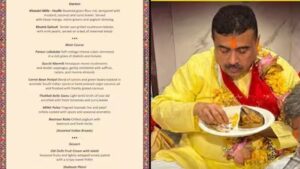
Suvendu Adhikari’s visit to Kalighat and the widely noticed consumption of fish bhog was not simply a meal. It was a strategic retreat, a cultural counter-offensive and a press release with bones in it. Why issue a clarification when you can pose with a fish head large enough to qualify as a regional identity marker?
The photograph said what political language never can:
“Please do not mistake our ideological commitments for a desire to lose elections.”
Sattvic Soft Power Meets Mustard-Oil Realism
The Centre’s problem is not vegetarian food. India has magnificent vegetarian traditions, cuisines and communities. The problem begins when one menu starts applying for the job of national spokesperson.
The all-vegetarian banquet is now expected to represent not merely a dietary preference but the entire Indian soul – tidy, fragrant and carefully plated for foreign consumption. It is the culinary equivalent of a government brochure: no visible mess, no sharp flavours, no arguments, and absolutely no fish curry threatening the upholstery.
But India is not a brochure. India is a railway-platform tiffin where idli, litti, pork, prawn, kebab, khichuri, bamboo shoot, beef, mutton, paneer, fish and seventeen varieties of pickle are all attempting to claim heritage status before the train leaves.
The trouble with imposing a single “national plate” is that every state already has one—and it is usually armed with ancestral recipes, religious practices, political memory and an electorate.
One Nation, One Appetite? Try Again
New Delhi may curate a global dinner with surgical precision. It may brand millet as diplomacy, saffron as civilisation and steamed vegetables as strategic autonomy. But the moment it tells a Bengali, a Malayali, a Northeasterner, a Goan, a Kashmiri, a coastal community or practically any family with a functioning kitchen what counts as respectable food, it discovers the limits of centralisation.
Federalism, after all, is not only about money, maps and ministries.
Sometimes it is about who gets to put fish on the deity’s plate – and who gets told, politely but firmly, to mind their own thali.