Shreeyansh Kar, Delhi, 24 January 2026
Four years ago, in the midst of the global pandemic, I kept myself busy by learning about the more positive sides of the world. I spent hours learning about the patterns found in thousands of flags. I memorised the number of countries on our planet and how they were all different from each other. I managed to gather invaluable information about the world and developed an increasingly important skill – the ability to ask, ‘Why?’.
On a seemingly random day, I thought to myself, where do all countries get their names from? In the case of my country, the Greeks pondered upon the Indus River and decided to call all the land beyond it ‘India’. I wondered if other countries had similar reasons for getting their names. In this quest of mine, I found myself excited after finding out the origin of the names of multiple countries. Even now, a bunch of these stories are at the tip of my tongue. Like how Singapore got its name after Sang Nila Utama saw a lion after first arriving on the island and hence, named it ‘Lion City’. However, out of all of these stories, the one which intrigued me the most was how Australia got its name.
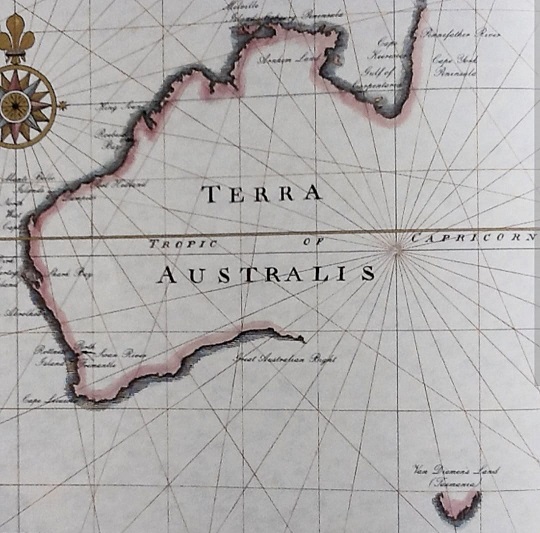
From the fifteenth century, mapmakers from Europe started to include a new landmass at the bottom of their map. They called it ‘Terra Australis Incognita’. This name means ‘The unknown southern land’. They believed that a large landmass in the Southern hemisphere of the Earth was required to counterbalance the large number of landmasses in the Northern hemisphere. I felt that such a belief was unscientific in nature. However, I had to keep in mind that science at that time was not nearly as evolved as it is during this era.
In 1606, the Dutch, who were in search of trade routes to the East Indies, discovered a piece of land which is now known as ‘Australia’. The Dutch explored the region and named it ‘New Holland’, which is funny because according to their own accounts, the place looked nothing like Holland.
When the British began to colonise the continent in 1788, they gave their navy the task of navigating ‘New Holland’. Matthew Flinders, a commander in the British Navy, became the first person in history to completely circumnavigate the continent. He created his own hand drawn map which used the name ‘Australia’ for the continent. He called it ‘Australia’ instead of ‘Australis’ because he believed that ‘Australia’ sounded more pleasing to the ears and that it followed the naming conventions used for continents.
Explorers at the time started becoming sceptical that their interpretation of the ‘Terra Australis’, which was an enormous continent, even existed. And thus, the popularity of the name ‘Australia’ surpassed that of ‘New Holland’.
Everyone at that time started believing that ‘Terra Australis Incognita’ was referring to Australia due to Matthew’s map. Well, that was until they discovered Antarctica, the rightful bearer of the name!
In 1820, multiple accounts from different explorers described an ice shore with an extreme height. Countries from all over the world were interested to know more about this new landmass so that they could do the one thing they did best. Colonise it, of course!
Expedition teams tried to get to this continent during the ‘Heroic age of Antarctic Exploration’ and many such expeditions were successful, but we are ignoring the important point here. What do we name this southern continent if a different country stole its rightful name? We shall create a new name, of course!
In the 1890s, John George Batholomew drew a map of this continent and named it, ‘Antarctica’. The name means ‘Opposite of the Arctic’, which is quite accurate as Antarctica is located on the south pole. But we can’t diverge our attention from the truth, that the name it deserved was ‘Australia’ or ‘Australis’.
It is a Shakespearean tragedy that there is a continent south of ‘The southern land’ but who do we blame for this misfortune? Certainly not the British or the Dutch. Not even Matthew Flinders. The ones to blame here are those who lost faith in the existence of the Terra Australis. If only they kept faith, then maybe Antarctica would have gotten its rightful name. The moral that I learned from this story is to never lose faith. So, let’s pray for a brighter future where no one ever loses faith and in this way maybe there will be no more naming misfortunes!
The author had submitted this article for the Queen’s Commonwealth Essay competition in the junior category in 2025 and received a bronze award for it.