
The Nirvik Bureau, Bhubaneswar, 5 June 2026
A Brief Power Cut in Accountability
In a state where electricity flows with occasional enthusiasm but profits surge with uninterrupted voltage, the sudden resignation of OERC Chairman P. K. Jena has been described officially as “personal reasons.” As always, the most personal reason in governance is public inconvenience – preferably caused by someone else.
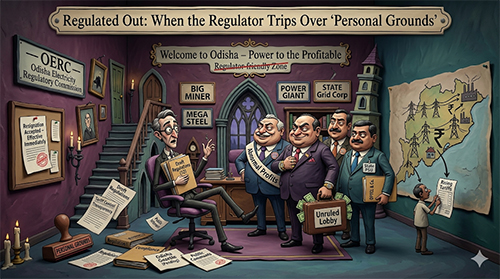
Behind this polite bureaucratic obituary lies a far more energetic drama: a corporate lobby so efficient that even regulators are now treated as renewable resources – used briefly, then discarded when they begin generating resistance instead of compliance.
When PSUs Discover Their Inner Corporates
Odisha offers a unique governance innovation: state-owned entities that behave like private corporations, and private corporations that behave like sovereign states. In this seamless ecosystem, accountability is merely a decorative word, much like “consumer protection” on an electricity bill.
Entities like OPTCL, originally designed to serve the public, appear to have undergone a spiritual transformation. They have transcended their humble origins to join the elite club of profit-maximizing institutions – except without the inconvenience of strict oversight. It is capitalism with government benefits, a sort of corporate yoga where flexibility is reserved exclusively for rules.
Regulation: The Most Offensive Proposal
Enter P. K. Jena, a man who committed the cardinal sin of taking his job description seriously. In just 13 months, he drafted not one or two, but twelve regulations – an act so radical it bordered on administrative extremism.
Regulation, in Odisha’s corporate ecosystem, is viewed much like a power outage: disruptive, unnecessary, and deeply unfair to those accustomed to uninterrupted profit supply. Jena’s proposals threatened to introduce concepts such as “limits,” “compliance,” and worst of all, “accountability.” Naturally, this could not be allowed to continue.
The Lobby That Cares Too Much
The corporate lobby, often misunderstood as a mere economic force, is in fact a deeply emotional entity. It cares – intensely – about its margins. Faced with the terrifying prospect of reduced “abnormal profits,” it reportedly worked with remarkable efficiency to ensure that regulatory enthusiasm did not reach the Gazette.
One must admire this coordination. In a country where paperwork can take months to move between two desks, the removal of an inconvenient chairman appears to have been processed with commendable speed. This is what happens when stakeholders are truly invested.
Sustainable Exploitation: A Growth Sector
The allegation that Odisha’s resources are being exploited unsustainably may sound alarming, but it is important to maintain perspective. Sustainability, after all, is a flexible concept. If profits remain sustainable, everything else is negotiable.
The real innovation here is the alignment of interests: corporations profit, PSUs participate, and bureaucracy facilitates. The public, meanwhile, contributes silently—mainly through tariffs and patience.
The Exit of an Outlier
Jena’s resignation is less an event and more a correction – an adjustment to ensure that the system continues to function as designed. Regulators are welcome, of course, as long as they regulate their own expectations.
His attempt to introduce order into a carefully cultivated disorder was admirable, if slightly misplaced. In Odisha’s current model, regulation is not absent—it is selectively applied, primarily to those who attempt to enforce it.
Curtain Call
As the corporate orchestra resumes its performance, one lesson stands clear: in the grand theatre of governance, the script is not written by those who draft regulations, but by those who draft profits.
And if a chairman occasionally forgets his role, the system is always ready to remind him – politely, efficiently, and if necessary, permanently.