
The Nirvik Bureau, Bhubaneswar, 30 May 2026
First we had an NEP that politely refused to be loved, then testing agencies practiced the ancient art of vanishing papers – now, if anyone asks for honesty, the Defence Ministry will politely escort the question out of the country.
The Education Ministry, bless it, has finally found its true calling: administration by improv. After unveiling a National Education Policy that flirted with acceptability and then ghosted the nation, the Ministry tried a new tactic – turning assessments into reality TV. Why trust clarity and procedure when you can hire spectacle?
First came the NEP: part manifesto, part suggestion box, part “we tried our best” letter to posterity. Critics called it fuzzy; architects called it visionary; bureaucrats called it “mission accomplished” and passed the baton. Enter the testing season, where NTA and NEET performed a disappearing-act the public might have envied if it weren’t the future of millions at stake. Question papers were misplaced with the same calm enthusiasm that a magician misplaces rabbits – only these rabbits had the faintest whiff of paid priorities.
A solution, they said, was technological: software to re-evaluate CBSE papers with mechanical precision and zero bias. Except that when the software tried to RSVP to the party, Telangana had already put it on the blacklist – apparently it brought the wrong kind of bugs. Did someone forget to tell the IT Minister? Or did the red flag receive a polite “we’ll see” and a signature? The Ministry accepted the software anyway, because governance is sometimes defined as the art of ignoring inconvenient footnotes.
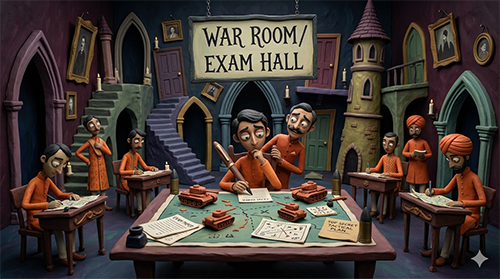
And then the Ministry, in a move of Olympic-level delegation, outsourced the distribution of exam papers to the armed forces. It’s a masterstroke. Armies have discipline, punctuality, and an established flair for secrecy – perfect for an enterprise where the primary objective is to keep questions under wraps. One can almost picture admirals and generals comparing envelope-stuffing techniques between branches, while education officers take notes and wonder if camouflage improves multiple-choice performance.
Loose lips? No need. Vendors empaneled with the Ministry provided logistical support and—curiously – the Education Minister’s daughter happens to be studying in the U.S. Her phone bill is mysteriously paid by decidedly domestic vendors with cozy ties to the very Ministry that manages the exams. Coincidence, say officials. Coincidence has many children in government, and they all go to private schools.
Why fuss about conflict of interest when you can have a family-friendly fiscal arrangement? Vendors pay bills, the daughter studies abroad, exam leaks keep the nation entertained, and the Defence Ministry doubles as the Education Ministry’s night watch. It’s a synergy. It’s also an elegant solution to accountability: when everyone is responsible, no one is blamed.
Somewhere an IT minister shrugs, a software blacklist gathers dust, and a question paper is routed through more ministries than a foreign delegation. Meanwhile, parents refresh web pages and dream the old dream: that merit, not messaging, will answer the call. But dreams are like standardized tests – they look neat on paper, unless someone with influence edits the questions mid-exam.
If satire has to end with a moral, let it be brief: when education becomes a relay race between ministries, vendors, and family invoices, the race is won by the one who controls the baton. The rest of us can only keep running, and hope the finish line isn’t written in invisible ink.