The Nirvik Bureau, Bhubaneswar, 4 June 2026
The Great Odisha Education Start‑Up
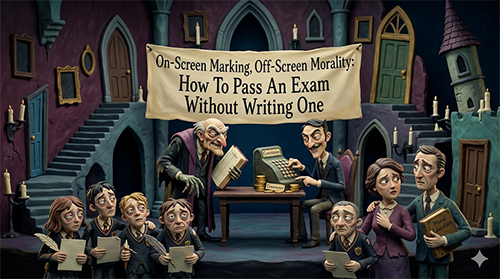
Odisha’s education system has finally joined the start‑up culture – they have discovered how to outsource accountability while insourcing scandal. The Council of Higher Secondary Education (CHSE) decided that if CBSE could turn evaluation into a tech circus, why should Odisha’s babus be left behind in the Stone Age of honesty. Thus was born the grand On-Screen Marking (OSM) sequel: “CBSE OSM Disaster – Odisha Director’s Cut.”
In this remake, a company called COEMPT appears on stage, technically ineligible, but spiritually very eligible – because who reads boring clauses like “technical criteria” when you have “managed criteria.” TCS, the boring IT giant, sat outside like a studious topper who did all the homework but forgot to bring the samosa for the teacher. Low price beat reliability, because in New India, per mark rate is more important than per student life.
Clause, Pause, and Full Stop
The tender politely said: “No sub-contracting.” Clause 2.27 even underlined it like a strict English teacher. CHSE then reportedly watched COEMPT sub-contract the entire show to Code Tantra and responded with the regulatory equivalent of “acha, thik hai, dekh lenge.” Clauses insisting on in-house software, source code ownership, data security, CERT-IN compliance, and end-to-end execution now lie in some PDF, functioning only as decorative literature for future law students.
On 18 April 2026, Code Tantra’s servers reportedly crashed, and with them, the illusion that anyone was actually in control. Evaluators across Odisha stared at frozen screens, while thousands of students’ futures temporarily went into “buffering…” mode. But don’t worry: in official language, this is not chaos; it is “technical glitch,” the same magical phrase that converts scams into “issues” and crimes into “concerns.”
Chor-Chor, Mausere Bhai
Meanwhile, at the national level, CBSE’s OSM saga was auditioning for its own web series. Tenders were floated once, twice, thrice – like a repeat exam for a favourite student – until the conditions reportedly bent enough for Coempt Eduteck to walk in as low-cost hero. Penalties were softened, blacklisting definitions massaged, and suddenly the company with a complicated past looked perfectly “future-ready.” After all, if you can allegedly be at the centre of a Telangana result fiasco and still return with a fresh name and a cleaner bio, why can’t students also be allowed a name change instead of a compartment exam.
Students get grace marks; companies get grace tenders. Students are told “cheating will destroy your future,” while Boards demonstrate in 4K how to allegedly cheat with tenders and still control everyone’s future.
Melrose, Mel-rose, Sab Kuch Rose
As if this wasn’t enough material for satire, social media helpfully added an international flavour. Posts began pointing out that a trust linked to the education minister’s family reportedly owns property in Melrose, USA, once used by his daughter during her foreign studies. The local “guardian” in that story is alleged to be a director of the very company now under the scanner in India’s OSM mess. Conflict of interest, of course, is an outdated Western concept; in Indian politics, it is rebranded as “family values” and “networking.”
Back home, allegations fly about SuM Hospital‑2, Nayanjori land allotments, encroachments, black money, and media houses acting as bodyguards for investments rather than watchdogs for democracy. The demand that hospital empires built on public land should offer free treatment to the poor sounds radical only because the poor were meant to contribute just votes, not medical bills.
National Demands, Local Syllabus
Citizens now demand CBI probes, judicial enquiries, blacklisting of companies, audits, action against officials, and written assurances that no student will suffer. It is touching, this faith that the same system that allegedly bent rules for contracts will suddenly straighten its spine for students.
But perhaps the real reform is already here: India has quietly introduced a new compulsory subject – Applied Hypocrisy with Digital Tools. The students are unwilling participants; the examiners are the real candidates. And looking at Odisha, CBSE, and the cosy company-government-media triangle, one thing is clear: in this great Indian exam, the question paper is leaked, the evaluators are compromised, and the only ones who consistently fail are the children.