The Nirvik Bureau, Bhubaneswar, 10 June 2026
When ideology is optional, loyalty is transferable, and voters are… decorative
In the great Indian political marketplace, loyalty now comes with a return policy. Terms and conditions apply, of course: the legislator must discover, post-election, that their “true ideological home” lies exactly where the ruling party sits. Coincidence is the backbone of democracy.
West Bengal is merely the latest showroom for this premium model of governance. The Trinamool Congress, once a roaring regional beast, now resembles a WhatsApp group where 58 out of 80 members have left but still insist they are the “real admins.” The original admin, meanwhile, is busy proving ownership of the group icon in court.
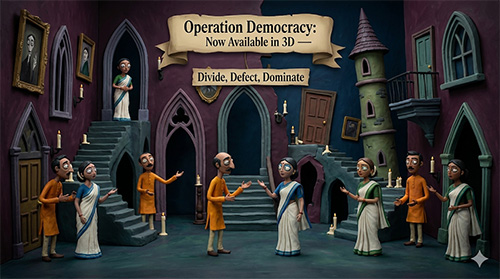
Welcome to Phase Three of the BJP’s patented political framework: Divide. Defect. Dominate. A strategy so efficient it deserves a startup valuation and a TED Talk.
Divide: Because Unity Is Overrated
The first step is philosophical. Every party, we are told, has “internal contradictions.” Some have ideology; others have leaders; most have both, but in separate rooms. The job is simply to introduce them to each other under stressful conditions.
In TMC’s case, the contradictions were already marinating: personality cult at the top, franchise operators at the bottom, and a middle layer held together by optimism and contracts. Add electoral defeat, and suddenly everyone remembers their “independent thinking.”
The result? A party that discovered democracy internally just as it began losing it externally.
Defect: The Great Migration Season
If winter is for birds, post-election season is for MLAs.
Observe the elegance: no one “defects” anymore. They “realign.” They don’t switch sides; they “respond to the people’s mandate,” which, curiously, always sounds like the ruling party’s manifesto.
In Bengal, MLAs and MPs have performed this ideological yoga with remarkable flexibility. Yesterday’s resistance is today’s cooperation. Yesterday’s corruption is today’s “administrative experience.”
And the voter? Still waiting for their representative to represent them, instead of representing their future cabinet prospects.
Dominate: Numbers Are the New Morality
Once the arithmetic settles, morality becomes a rounding error.
The anti-defection law, designed as a moral fence, now functions more like a decorative hedge. As long as you bring enough people with you, the system rewards collective betrayal as “legitimate restructuring.”
It’s less “Aaya Ram, Gaya Ram” and more “Bulk Order Discount.”
Meanwhile, institutions watch closely, like referees in a match where the rules are rewritten mid-game and the scoreboard updates itself.
Bonus Feature: The Voter Vanishing Act
Somewhere in this grand choreography lies a forgotten character: the elector.
The voter, who chose a candidate based on party, manifesto, or at least a recognizable face, now witnesses their mandate being transferred like a mobile number. No consent required.
Representation has evolved. It no longer flows from people to power, but from power to whoever is willing to receive it.
Final Curtain: Democracy, Now Streaming Live
The tragedy is not that parties split. That’s politics. The tragedy is that accountability dissolves while legality puts on a brave face.
When 58 MLAs can wake up as the “real party,” and 20 MPs can hover as a “supporting bloc,” democracy begins to resemble experimental theatre – bold, confusing, and largely unintelligible to the audience that paid for it.
And yet, the show goes on.
Because in New India’s political cinema, the script is simple:
You don’t need to win the people.
You just need to win their representatives – eventually.