The Nirvik Bureau, Bhubaneswar, 24 July 2026
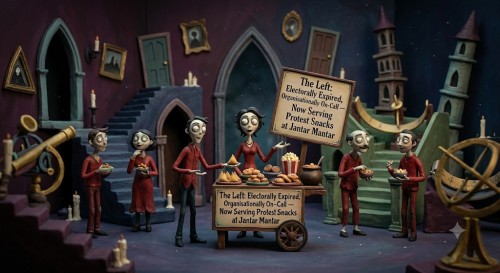
Out of votes but in the queue — the Left installs its service counter where grief, grievance and Gen Z impatience come to wait.
Once upon a sultry evening at Jantar Mantar, history performed its favourite trick: it died electorally, rose theatrically, and went to join the queue. The Left, long certified by pundits as officially deceased at the ballot box, turns out to be a remarkably lively corpse – the kind that hoards placards, hands out thermals and knows exactly where to stand to look spontaneous.
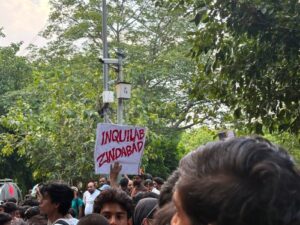
You can spot it by the telltale symptoms: a Che Guevara poster that’s seen more Instagram filters than a Lenin statue ever did, a cluster of student unions whose membership rolls resemble an outdated rolodex, and cadres who still treat agitation like a weekend hobby. Their motto seems to be: “We may not win seats, but we will certainly win selfies.”
Of course, the anger at Jantar Mantar is organic – the sort of slow-brewing, multi-city, algorithm-accelerated frustration born from NEET nightmares, AI anxieties and a job market that behaves like a subscription you forgot to renew. But whenever a collective irritation reaches critical mass, the Left arrives with all the efficiency of a well-meaning aunt at a family crisis: first carrying tea, then slogans, finally claiming to have been the idea’s emotional guardian since childhood.
This is political recycling at its best. An authentic grievance enters the square. The Left recognises the scent of discontent, approaches politely, and within hours has knitted it into an ideology-friendly shawl. It’s less appropriation than matchmaking: organic anger + seasoned organisers = a protest with managed chants and a reliable sound system. If movements were restaurants, the Left would be the franchise that opens near every sudden surge of hunger.
The BJP, understandably, prefers to stare into the crowd and squint until it finds an invisible hand. “Who is behind it?” they ask, as if protests were Ikea furniture assembled by a single allen key of conspiracy. The Left answers instead with practiced calm: “We’re not behind it; we’re beside it – with files, flags and an ace list of student contacts.”
This relationship suits both. The students get choreography and continuity; the Left gets to remain culturally alive without the messy business of winning votes. The electorate loses nothing but occasionally an election; the Left loses nothing either – except, perhaps, relevance at the ballot box, which, given the decades of obituary notices, is apparently optional.
And there is the generational irony: young protestors line up for hours because they fear there are fewer ladders and more locked doors. They chant for dignity and futures while older political elders paginate their speeches and fume about “organised dissent.” The Left, with its museum-quality cadres, comforts them: “Sit. We know how to keep a queue disciplined.” It is the comforting hand of an institution that once built unions and now supervises hashtags.
So rejoice: the Left is dead at the ballot box, alive at the protest podium, and on standby in the queue. It cannot win the next election but will happily influence the next slogan. Meanwhile, India’s youth wait – not for a party, but for a future that isn’t a commentary section.