The Nirvik Bureau, Bhubaneswar, 19 September 2026
A guru who renounced the world returns as a blockbuster franchise, a traffic-management problem, and a premium blanket opportunity.
At Kainchi Dham, salvation may be free – but parking, hotel rooms, reels, and devotional merchandise have found their own path to moksha.

There was a time when a person went to the Himalayas to escape worldly attachment. Now one goes there after booking a RedBus ticket, reserving a “Baba View Deluxe Room,” and checking whether the temple’s aarti will look better in cinematic mode or portrait.
Neem Karoli Baba, the blanket-wrapped guru who died in 1973, has apparently returned – not through reincarnation, which would be too old-fashioned, but through the more dependable medium of a Rs 300-crore biopic. Hanuman Ansh, made for Rs 2 crore, has done what most spiritual movements struggle to do: it has achieved both transcendence and an exceptional return on investment.
This is the beauty of modern faith. Earlier, miracles involved curing illness, feeding strangers, or appearing in two places at once. Today, the miracle is a low-budget film grossing 150 times its cost while producing a pilgrimage rush large enough to test the patience of Hanuman himself. The deity who once carried a mountain now has to watch devotees carry selfie sticks through mountain traffic.
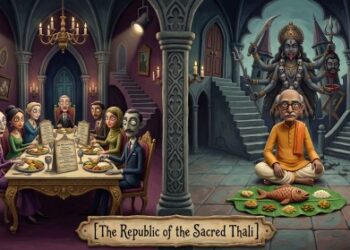
At Kainchi Dham, people wait in drizzle for aarti, chant “Sitaram,” and surrender their footwear before the sanctum. No VIP queue, we are told. This is a moving democratic principle: all are equal before God, though some are equal before the parking contractor, the hotel receptionist, and the person selling “authentic Baba Kambal” at a spiritually revised price.
The blanket is particularly important. Baba’s iconic plaid covering, once merely an ascetic’s garment, is now a devotional lifestyle product. Only Raymond blankets are offered, because evidently even renunciation requires brand assurance. The divine may be everywhere, but quality control must remain with a heritage textile company.
A local shopkeeper recalls the miraculous day a Raymond agent appeared just when he needed one. Skeptics may call it market expansion. Believers call it chamatkaar. Either way, the agent clearly understood the deepest teaching of Indian spirituality: where there is devotion, there is distribution.
The guru’s message has travelled an impressive route. First came wandering, meditation, temples and disciples. Then came Richard Alpert becoming Ram Dass, Steve Jobs reportedly visiting India, Zuckerberg discussing difficult times, Modi visiting Facebook, Virat Kohli and Anushka Sharma visiting the ashram, and finally every young person with an internet connection discovering that inner peace can be geographically tagged.
The modern pilgrim does not merely seek the divine. They seek proof of having sought it. A reel outside the shrine, a photograph near the marble statue, a caption saying “Called by Maharaj ji,” and perhaps an audio track with a flute gently telling the algorithm that one has healed.
Meanwhile, in Akbarpur, where Baba was born as Lakshman Narayan Sharma, the sacred economy has not fully arrived. There are family disputes, broken roads, pooled sewage, and a cremation ground without a roof. This is where spirituality meets governance and discovers that municipal development has not yet received enlightenment.
The villagers hope the tourism circuit will bring better roads, drainage, and perhaps a roof over the cremation ground. It is a modest prayer. In a country where gods receive marble, garlands, floodlights, and branded blankets, the dead are still negotiating for protection from rain.
Perhaps that is the final lesson of Baba’s new generation: faith can create crowds, commerce, cinema, and a very healthy blanket market. But if it cannot create a covered cremation ground, then maybe the miracle needs a district tender.