The Nirvik Bureau, Bhubaneswar, 28 July 2026
From Aspirant to Client: How Students Became Customers of Crime
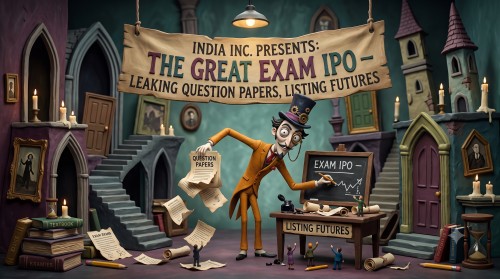
When you turn 20 lakh anxious students, 6% government seats, and a ₹1.2 lakh crore coaching economy into one giant lottery, don’t be shocked when someone starts selling the winning ticket.
By now, you already know that exam paper leaks are no longer a scandal in India; they’re just another sector in the economy. We have IT, FMCG, real estate, and now proudly, Organised Question Paper Services (OQP Pvt Ltd) – backed by robust networks, encrypted platforms, and the occasional politician’s nephew doing “business development.”
Economists, bless their optimistic hearts, call this a problem of scarcity. In India, we call it reservation… but for crooks.
Take NEET, the medical entrance exam – that sacred ritual where nearly 20 lakh students compete for under 3% of seats, just so they can eventually write prescriptions like “paracetamol sos” and charge consultation fees for saying “drink water.” The government medical college seat is the golden ticket: a full MBBS for less than ₹30,000. The private college version comes with a free cardiac arrest at the billing counter.
Naturally, when the prize is that juicy, rent-seeking walks in wearing shades and a fake Aadhaar card.
Rent-seeking, as Gordon Tullock and Anne Krueger politely described, is about influencing the system instead of competing fairly. In India, we have upgraded this to “shortcut culture”. Why study organic chemistry when you can just organically connect with a guy on Telegram offering the entire paper for ₹30 lakh? It’s not cheating, it’s *smart networking*. LinkedIn endorsements will be added soon: “Highly skilled in: Securing question papers before they exist.” At the top of this pyramid sit the kingpins, running a pan-India logistics miracle that would make Amazon blush. Printing press insiders, transport staff, exam centre officials – everyone gets a cut, like a perfectly coordinated group project where, for once, nobody is free-riding. The leaked papers travel more safely than actual vaccines.
You’d think with this level of enterprise, the law would slam down hard. And it tried. The Public Examinations (Prevention of Unfair Means) Act, 2024 arrived with 5–10 years of jail and a minimum ₹1 crore fine for organised leaks. Noble effort – except some rackets make up to ₹60 crore per season. That’s not punishment, that’s a minor operational expense. If your crime’s EBITDA can absorb the penalty, you don’t call it “risk”, you call it “cost of doing business.”
Convictions? Rare. Cases drag on, evidence piles up, public attention moves to the next breaking news alert, and the accused remain out on bail, probably preparing their children for the same exams using the same “family business discounts.”
The law, naturally, has gaps. It covers central exams like NEET, JEE, UPSC, IBPS – the marquee brands. State-level exams are like the unregulated start-up space: high growth, low compliance. Get blacklisted in one state? Just rebrand in another. From “Sharma Paper Solutions” to “Sharma Educational Consultants” – problem solved, vision unchanged.
Meanwhile, the NTA is being run like a temp agency. With only 24 permanent staff against 197 contractuals, we’ve essentially outsourced integrity. Sensitive tasks – paper setting, printing, transport – all entrusted to people who may not even be there next month. Accountability is difficult when HR itself doesn’t know who showed up today.
The economic fallout is spectacular. Exams cancelled, retests ordered, crores burnt in logistics, and families’ ₹1.2 lakh crore annual investment in coaching turned into emotional scrap. But the real tragedy is this: the ones who buy leaked papers don’t just steal ranks; they eventually become doctors. So your future surgeon may have first mastered “Ctrl+C, Ctrl+MBBS” before touching a scalpel.
Solutions? Of course, we have some.
Make leaks a loss-making enterprise: punishments that hurt more than profits. Professionalise NTA: hire actual staff instead of treating national exams like a seasonal pop-up store. Move more exams online: if you can trade in the stock market on an app, you can probably answer Physics MCQs on a secure server.
The government says reforms are underway, laws might expand to cover state exams, fines could go up to ₹10 crore, and sentences to 10 years. Sounds promising. But trust, once leaked, is harder to rebuild than a question paper.
Until then, India’s brightest will continue to compete in a system where merit is optional, but having the right contact saved as “Bhaiya – Last Minute Help” is compulsory.