The Nirvik Bureau, Bhubaneswar, 31 July 2026
When Jersey Shades Replace Game Plans
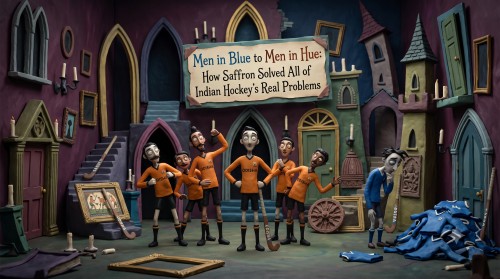
In a historic leap backwards for Indian sport, the legendary blue jersey of Indian hockey has reportedly been retired in favour of saffron – because if you can’t change the medal tally, you can at least change the RGB code.
For decades, blue was not just a colour; it was an emotion, a legacy, a reminder of Olympic medals won by teams who thought more about penalty corners than Pantone charts. It was derived from the blue Ashoka Chakra, but apparently the chakra has now received a party transfer, along with a complimentary shade card and a moral lecture.
After all, why should jerseys be allowed to remain non-partisan when bridges, buses, and buildings have already been given loyalty tests by a colour-blind government that can only see one tint?
Odisha – From Sponsor State to Background Colour
In a time when corporates were busy sponsoring cricket ads and conscience-free profits, it was Odisha that stepped up to sponsor Indian hockey. The state didn’t just put money; it put pride, identity, and emotion into those blue jerseys. Every Odia across the globe treated the team as their own – because it was.
Now, with one election and one new government, that emotional investment has been reclassified as “old stock” and moved to political clearance sale. The message is simple: “Thank you for 41 years of waiting and finally getting an Olympic medal – but your colour scheme is no longer electorally viable.”
The former Chief Minister’s anguish is understandable. You spend years building a sporting culture, grooming a legacy, and nurturing a national symbol, only to discover that all of it can be dry-cleaned out in one laundry cycle at the Saffron & Sons Colour Correction Centre.
National Symbols, Now With Party Membership
We were once told that national symbols exist to unite us. The flag, the emblem, the blue chakra – all supposedly above politics. But in New India, symbolism is like a party worker: available for deployment, repainting, and transfer, depending on poll season.
The blue jersey was our version of Argentina’s stripes or Brazil’s yellow: instantly recognisable, emotionally loaded, and proudly non-negotiable. To tamper with that is not “rebranding”; it’s cultural vandalism with a colour palette.
But fear not. As authourities insist that no pressure was applied, the new Odisha government continues its noble mission: repainting buildings, buses, and now, apparently, history. One might mistake them for interior decorators, if not for the occasional reminder that this is, in fact, a government.
Hockey, Politicised by Shade Card
Hockey, a national game that already struggles for attention, now finds itself rebranded as a walking manifesto. Players used to worry about formations and fitness; now they must also wonder whether their jersey is a “vote bank colour” or a “cultural statement.”
The former CM calls it “petty politics of the worst kind.” That’s generous. This is politics so petty it needs a magnifying glass and a microscope to be taken seriously, yet it still manages to hurt lakhs of sports lovers who thought they were cheering for a country, not a colour campaign.
In the end, the blue jersey belonged to every Indian. Saffron, we are told, also belongs to everyone – though coincidentally, it seems to belong a little more to those in power. The real tragedy is not just the change in shade, but the shrinking of imagination: a government that can repaint everything except its priorities.
If only medals were awarded for “Most Things Recoloured in Two Years,” India would already be on the podium, national anthem playing, men and women standing proud in their new jersey – colour-coded for compliance, but still searching for that old feeling that used to be called… blue.