The Nirvik Bureau, Bhubaneswar, 12 August 2026
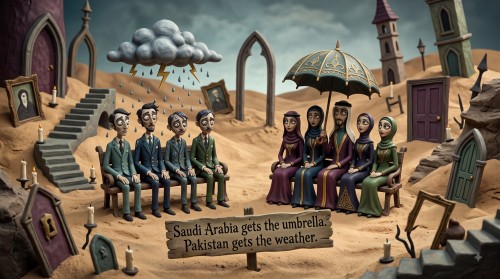
In the latest regional innovation, Riyadh gets a security umbrella, Ankara gets influence, and Islamabad receives the privilege of discovering what “collective defence” means after the missiles arrive.
The Gold-Plated Umbrella
A magnificent new Saudi-Pakistan-Turkey defence pact has reportedly arrived, wrapped in diplomatic ribbon, scented with strategic ambiguity, and signed beneath enough royal titles to exhaust an entire printing press.
Its core idea is charmingly simple: an attack on one is an attack on all. Like a neighbourhood WhatsApp group, except the messages may involve ballistic missiles, naval blockades, and sudden requests for “a few thousand troops, nothing dramatic.”
Saudi Arabia gets what it has long wanted: a large, nuclear-capable friend standing in the background, looking sternly at the horizon. Turkey gets another chair at the high table of regional relevance. Pakistan, meanwhile, gets a fresh opportunity to convert its chronic shortage of dollars into an abundant supply of obligations.
This is not a pact. It is a geopolitical buy-now-pay-later scheme.
The Deterrence Menu
The agreement wisely avoids explaining precisely whom it is defending against. This is excellent diplomacy. Why limit yourself to one potential catastrophe when you can maintain flexibility?
Iran? Israel? The Houthis? Pirates? A strongly worded regional tweet?
The pact merely says that deterrence will be “strengthened.” This is like a restaurant announcing that its soup will be “improved,” without clarifying whether the improvement is salt, pepper, or an intercontinental missile.
For Saudi Arabia, the appeal is evident. The Kingdom has watched missiles, drones, oil-route pressures and regional chaos arrive with the frequency of discount-season notifications. A Pakistani deterrent, preferably with a discreet nuclear glow around the edges, offers reassurance. It is security with optional atomic accessories.
Pakistan, however, may find that extended deterrence is rather like extending one’s credit limit: initially exhilarating, eventually visited by men carrying paperwork.
Please Defend the Kingdom – But Not Too Much
Pakistan has historically been happy to guard Saudi soil, holy sites and strategic facilities—provided the assignment comes with clear boundaries, suitable allowances and no unexpected invitation to a sectarian quagmire.
The real test begins when “collective defence” stops being a phrase at a summit and becomes an urgent call at 3 a.m.
“Hello, Rawalpindi? There has been an incident.”
“What sort of incident?”
“The kind involving drones.”
“And where?”
“Somewhere near the border.”
“Ah. Our troops are trained for defensive deployment.”
“This is defensive.”
“Of Saudi territory?”
“Technically.”
“Then please consult the parliament, the oil ministry, public opinion, Iran, China, domestic sectarian sensitivities, and perhaps the weather department.”
That is the difficulty with security guarantees: everybody loves the guarantee until someone tries to redeem it.
The Nuclear Loyalty Card
Pakistan’s nuclear arsenal has been built around its own strategic compulsions, especially its rivalry with India. Turning it into an informal regional loyalty card for richer friends could require money, capability, doctrine, diplomatic cover and—most inconveniently—a willingness to accept retaliation for someone else’s emergency.
Saudi funding may ease fiscal pressure, certainly. But money rarely comes alone. It tends to bring expectations, cousins, consultants and a detailed agenda.
And in this arrangement, China will not be an invisible guest. Any serious Pakistani expansion carries a Chinese shadow, technical or strategic. Thus a Saudi shield could quietly acquire Chinese stitching, Turkish embroidery and Pakistani liability.
The Enemy-Shaped Hole
The pact’s greatest achievement may be its ability to form an alliance without naming an enemy. Every capital insists it is aimed at nobody. This makes it perhaps the world’s first mutual-defence arrangement designed to protect its members from an unspecified inconvenience.
It is a fire brigade that refuses to identify fire.
Pakistan may gain diplomatic stature, Saudi favour and short-term strategic room. But it may also discover that becoming indispensable is simply another way of becoming unavailable – to itself.
In the Middle East’s great bazaar of influence, Pakistan has rented a prominent stall. The trouble is that the rent may be paid in troops, missiles and consequences.