The Nirvik Bureau, Bhubaneswar, 18 August 2026
The nation has many songs. It merely lacks the habit of listening.
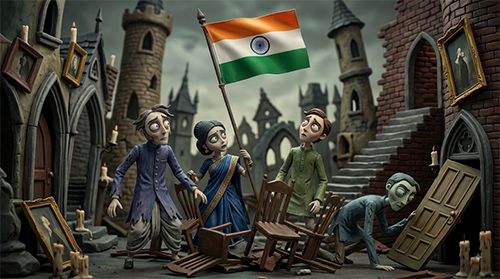
A committee somewhere has announced that India needs a new song – a modern tune for a modern republic. Not to replace the national anthem, of course. Nothing so alarming. Just an additional patriotic number, something young people can hum while negotiating potholes, job portals, identity checks and the ever-expanding syllabus of acceptable emotions.
It must be uplifting. It must be inclusive. It must celebrate diversity – provided diversity arrives on time, wears appropriate clothes and does not bring up land rights, caste violence, unemployment, Manipur, lynching, women’s safety, forest displacement, or the minor administrative inconvenience known as equality.
The song should have a pleasant chorus. Something like:
One nation, one beat, one slogan for the screen,
If reality looks untidy, apply a patriotic sheen.
Raise the flag, mute the question, clap on cue and grin-
The nation is doing splendidly. Please do not look within.
Lyrics Subject to National Security Clearance
Earlier patriotic songs were rather careless. They spoke of communal harmony, human dignity, labour, justice and the rather reckless proposition that the country belonged to its entire people. Some even suggested that loving India meant caring for Indians.
This was charming, but impractical.
Today, patriotism is a more sophisticated product. It comes with studio lighting, orchestral drums, aerial shots of highways and a mandatory close-up of someone saluting in slow motion. The lyrics must not be too complicated. A citizen humming the song should not accidentally develop constitutional thoughts.
Words such as “freedom,” “justice” and “fraternity” can be included, but only as decorative items – like indoor plants in a government office. They should look healthy in the video and receive no actual sunlight.
The Margins Have Submitted Their Verses
Unfortunately, several people wish to contribute lines to the new national song.
Dalits have asked that “equality” be more than a chorus sung once a year. Adivasis want forests described as homes, not empty green patches waiting politely for excavation. Women wish to know whether “freedom” includes walking safely, earning fairly and being believed. Queer citizens have requested that love be allowed a stanza without first appearing on a shouting panel called: “Is Affection a Threat to Civilisation?”
Then there are people from troubled regions who have sent recordings of grief, anger and disappearance. The committee is reviewing them carefully, which is bureaucratic language for placing them in a folder titled “Future Consideration.”
The nation welcomes every voice, naturally. It simply prefers some voices as background vocals.
Auto-Tune the Republic
We are not short of patriotic music. Every national occasion produces enough songs to keep a small army of flag-waving influencers employed until the next public holiday. We have remixes, rap versions, devotional versions, military versions and cinematic versions where the flag receives better character development than most citizens.
What we do not have is a song that can survive a question.
A genuine anthem for the present would have to include the unemployed graduate refreshing a recruitment page, the farmer listening to promises on a broken radio, the student facing a lathi charge, the family waiting outside a hospital, the worker walking home after the city decides labour is essential but labourers are optional.
That song may not be suitable for a grand launch. It may not have fireworks. It may make the sponsors uncomfortable.
But perhaps the new national song should not begin with a trumpet. Perhaps it should begin with the sound we have spent years trying to silence: people speaking together.
Sing for the nation, by all means –
but keep a verse unmuted
for those the anthem forgot to name.