The Nirvik Bureau, Bhubaneswar, 26 August 2026
GIVA withdraws ad after discovering that Indian culture is apparently stored in a blouse measurement

In a development that has shaken the nation more than inflation, unemployment and the annual disappearance of footpaths during monsoon, a Raksha Bandhan advertisement starring Kriti Sanon has been withdrawn by jewellery brand GIVA after social media detected an alarming cultural violation: a woman had worn an outfit.
The ad reportedly portrayed Raksha Bandhan as a celebration of affection, protection, family and – in a shocking expansion of the concept – pets. But viewers rapidly identified the real threat to civilisation: an ivory ensemble whose neckline had allegedly wandered too close to constitutional territory.
Within minutes, thousands of self-appointed textile archaeologists assembled online to examine the garment. Some measured the blouse using spiritual geometry. Others consulted ancient scriptures, WhatsApp University PDFs and screenshots from 1997 television serials. Their conclusion was unanimous: the festival had been endangered by fabric insufficiency.
Culture found hiding behind a curtain
For centuries, Raksha Bandhan has symbolised a promise of protection. But modern society has upgraded the tradition. It now appears that the brother’s principal duty is not protecting his sister from danger, inequality or harassment. It is protecting her from her own wardrobe.
This is an efficient arrangement. Why confront violence against women when one can confront a sleeveless blouse? Why discuss equal inheritance, safe public spaces, workplace harassment or unpaid care work when the nation can have a three-day emergency debate on whether a neckline is sufficiently patriotic?
Kriti Sanon responded with the inconvenient suggestion that festivals are about emotions and meaning, not clothing. Such a claim, naturally, has been treated with suspicion. If culture resides in the heart, as she argues, then what will social-media outrage squads inspect? Character cannot be zoomed in on, circled in red, and forwarded with the caption: “SHAME!!!”
The actor also mentioned that she and her sister tie rakhi to each other, recognising that women can protect one another too. This proved especially unsettling to those who prefer tradition served only in rigid, pre-approved gender packaging: brother protects sister; sister serves sweets; everyone ignores the fact that the sister has been protecting the entire household’s emotional infrastructure since birth.
The blouse police report for duty
Kangana Ranaut’s criticism of the advertisement added essential constitutional clarity. Women, she reminded the public, have many clothing options: saris, salwar kameez, lehengas, jeans, cocktail dresses and bikinis. Freedom, therefore, is abundant – as long as women exercise it by choosing the option most likely to satisfy strangers.
What a magnificent vision of empowerment: a woman may wear anything she wants, provided a panel of anonymous men, offended aunties, political commentators and celebrity moral consultants agrees it is appropriate for the occasion.
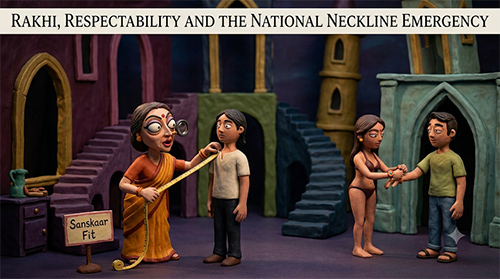
One eagerly awaits the official festival dress code, perhaps issued by the Ministry of Cultural Stitching. It may include a colour chart, a list of permissible sleeves, a neckline depth calculator and a government-certified “Sanskaar Fit” label.
“Warning,” the label might read. “This garment contains independent thought. Keep away from public festivals.”
Brand apologises to the outrage economy
GIVA, meanwhile, issued the standard corporate apology: it respects culture, traditions, festivals, families and probably the sacred right of people to feel personally injured by an advertisement they could simply scroll past.
The brand said its intent was to include pets in the celebration because pets are family. An admirable sentiment, though perhaps premature. Before granting dogs emotional membership in the household, society must first decide whether they are properly dressed for Raksha Bandhan.
The ad has now been removed, culture has been temporarily rescued, and the nation can return to its crucial duties: monitoring women’s clothes, misreading symbolism, and protecting tradition from the unbearable danger of joy.