The Nirvik Bureau, Bhubaneswar, 25 September 2026
New voter registration now comes with a family-history quiz, a legal trapdoor, and the soothing assurance that everything was decided “unanimously.”
New voters across India have reportedly discovered that casting a vote is no longer merely a matter of being 18, a citizen, and alive enough to locate an internet connection. It is now also an ancestry project.
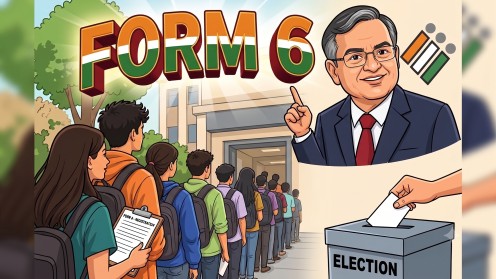
Welcome to Form 6: The Heritage Edition.
The humble voter-registration form – once content with such quaint details as name, age, address, photograph and proof that one has not emerged from a government printer – has acquired a new mandatory feature: applicants must declare whether they, their parents or their grandparents appeared in an old electoral roll during the last Special Intensive Revision.
In other words, before democracy permits you to enter, it would like to meet your ancestors.
An 18-year-old applicant may have been born in 2008, but the online portal appears to be asking the deeper constitutional question: “Yes, yes, but where was your grandmother’s name in 2003?”
This is a refreshingly modern approach. Other countries waste time verifying identity, citizenship and residence. India, always committed to innovation, is apparently exploring genealogical democracy. Why should a first-time voter merely prove who they are when they can also prove who their family was, where they lived, and whether they successfully survived the administrative archaeology of two decades ago?
A three-option menu, minus the explanation
The applicant is asked to choose among three possibilities:
- My name appeared in the old roll.
- My parent or grandparent’s name appeared in the old roll.
- Neither appeared.
The first option is ambitious, given that most first-time voters were busy being toddlers – or not yet having been invented – when several of these earlier rolls were prepared.
The second option requires families to retain electoral documents with the dedication normally reserved for royal bloodlines, inherited property disputes and wedding jewellery.
The third option, “Neither,” is perhaps the most thrilling. The form does not reportedly explain what happens after one chooses it. This creates an atmosphere of civic adventure. Will the applicant be registered? Asked for further documents? Redirected to a cave where a bureaucratic oracle asks riddles? No one knows.
It is democracy with a surprise ending.
The first-time voter who has voted before
Meanwhile, millions of voters removed during the Special Intensive Revision are reportedly being directed towards Form 6 to get their names restored. This is where the state’s administrative theatre becomes especially elegant.
Form 6 requires the applicant to declare that they are applying for inclusion for the first time and are not already enrolled elsewhere.
But a deleted voter was, inconveniently, already a voter. Some may even have voted repeatedly, paid taxes, complained about potholes, argued about elections on WhatsApp, and developed the full emotional range of citizenship.
Now they must apply as beginners.
It is like being thrown out of a library and then told to return only after swearing you have never seen a book.
The difficulty is not merely philosophical. Making a false declaration in connection with electoral rolls can carry penalties. So a voter whose name was removed may face a choice between remaining absent from the rolls or signing a statement that seems to deny their own documented existence.
A wonderfully efficient system: first erase the citizen, then ask why the citizen cannot honestly claim to be new.
Unanimity, with two objections
Reports say that two Election Commissioners objected to the change, calling it “illegal” and “unauthorised,” on the grounds that a prescribed statutory form cannot simply be redesigned online like a food-delivery app’s checkout page. Rules, they noted, are generally amended through notification, consultation and parliamentary procedure – not by adding a compulsory question between “Upload photograph” and “Enter captcha.”
The response: internal disagreements are part of the normal decision-making process, while decisions have been unanimous.
This is a deeply reassuring definition of unanimity. In the upgraded version, unanimity does not necessarily mean everyone agreed. It means disagreement occurred privately, after which agreement was declared publicly.
Soon, perhaps, citizens too may enjoy this efficiency. When asked whether they consented, they can simply reply: “I had reservations, therefore I enthusiastically approved.”
The voter as a family archive
The new arrangement appears especially considerate towards migrants, poorer households and families whose papers did not travel with them through relocations, floods, evictions, marriages, deaths, changing state boundaries, and the general Indian tradition of official records being stored somewhere between a steel trunk and divine providence.
The young voter, meanwhile, learns an important lesson before casting a first ballot: democracy is not just a right. It is an intergenerational documentation competition.
And if your grandparents cannot be found in a two-decade-old roll, do not worry. The system has not rejected you.
It has merely asked you to prove that your family tree is eligible to stand in the queue.