The Nirvik Bureau, Bhubaneswar, 25 October 2026
Viksit by 2036. Germination Date Uncertain
Kalahandi is being developed into an integrated cotton hub. The integration is already impressive: farmers supply the land, banks supply the debt, traders supply the promises, and the administration supplies the future tense.
Under “Viksit Odisha 2036,” cotton will apparently travel from seed to shirt within the region. For now, it travels from the farmer’s field to another state, while the farmer travels from one office to another.
This is called a value chain. Everyone along it adds value to their own pocket.
The farmer adds another mortgage.
Certified Organic. Organically Certified.
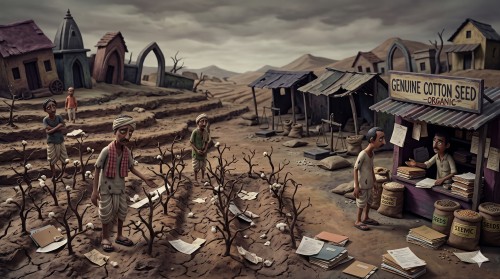
The proposed revolution has encountered a minor agricultural inconvenience: seeds allegedly reluctant to produce cotton.
The plants grow luxuriantly, displaying the sort of vigorous upward mobility usually associated with contractors. Unfortunately, they neglect to develop bolls.
Officials may wish to classify this as “foliage-led development.”
Why insist on cotton? Leaves are green. Green is sustainable. Therefore, a field without cotton may simply be an exceptionally successful environmental initiative.
Meanwhile, agencies accused of circulating dubious organic certificates appear to have discovered the district’s most productive crop: certification.
Unlike cotton, paperwork requires neither irrigation nor honest germination. Plant one signature in a sufficiently fertile office and, allegedly, crores may blossom.
The farmer receives a certificate of participation in his own ruin.
Local Minister, Imported Accountability
The Agriculture Minister’s western Odisha connection should offer reassurance. Surely, someone familiar with the region can distinguish a cotton boll from a briefing folder.
Yet the account presented leaves an obvious question: where is the minister’s clear public response to these allegations?
Perhaps it is being processed.
Perhaps it requires a feasibility study, departmental concurrence and a ceremonial lamp.
Regional representation is a wonderful arrangement: the minister comes from your region, while explanations arrive from nowhere.
But silence is not proof of complicity. Asking whether the minister is involved requires evidence, not merely an excellent opportunity for a punchline. What citizens can reasonably demand is less mysterious: an investigation, published findings and consequences.
A microphone would also be a promising agricultural input.
Closed Mandis, Open Possibilities
The district’s procurement mandis reportedly remained shut for two seasons.
An elegant solution to farmer dissatisfaction: eliminate the place where farmers might express it while selling their crop.
Without sufficient local processing, raw cotton leaves for neighbouring states. Kalahandi exports the material; others retain the margins.
This is decentralisation, provided one understands that profit must be decentralised away from the producer.
Proposed spinning mills remain especially appropriate. There is already considerable expertise in spinning.
Seed to Market, Desk to Desk
Experts recommend checkpoints against illegal seeds, effective procurement and reliable suppliers.
These are sensible measures, although they suffer from a serious administrative defect: they can be checked.
A vision document is safer. Nobody can inspect a cotton boll scheduled for 2036.
Until accountability arrives, Kalahandi’s farmer must practise extraordinary patience: sow money, irrigate with anxiety and wait for the government to announce another bumper harvest of intentions.
The cotton cluster, meanwhile, is flourishing.
On paper, the fibre is excellent.