The Nirvik Bureau, Bhubaneswar, 27 October 2026
Territorial Integrity, Subject to Proofreading
Odisha can relax. Its chief minister has secured a strategically important piece of territory: the newspaper’s opinion page.
Kotia remains disputed between Odisha and Andhra Pradesh, but there is no ambiguity about the ownership of the byline. That belongs firmly, constitutionally and photographically to Mohan Charan Majhi.
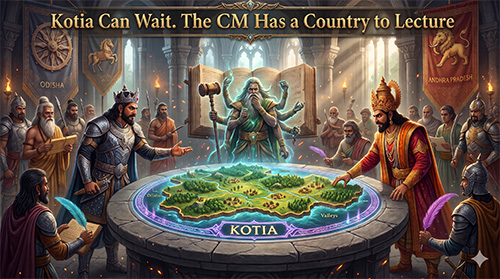
Inthe secretariat, an officer enters carrying a map.
“Sir, Kotia.”
“Which newspaper?”
“No, sir. The villages.”
The chief minister looks disappointed. Villages are troublesome things. Unlike paragraphs, they contain people who expect something to happen after the opening statement.
“Have we reiterated our commitment?”
“Yes, sir.”
“Firmly?”
“Very firmly.”
“Then why are you still holding the map?”
An Excellent Command of Other People’s Failures
In his column, Majhi prosecutes Congress’s record on institutions. In his Kotia reply, he reiterates Odisha’s territorial claim, criticises Naveen Patnaik’s political approach and invites constructive suggestions.
A magnificent contrast: complete prosecutorial confidence about yesterday; a suggestion box for today.
“Sir,” asks the officer, “shall we prepare a clear account of our next steps?”
“First explain what Congress did in 1973.”
“And Kotia?”
“Include it under pending matters.”
The government’s historical vision is evidently excellent. It can identify a judicial supersession across five decades. The difficulty begins when the subject moves closer to home.
Perhaps Kotia should apply for recognition as a Congress scandal. It might finally receive sustained attention.
Please Don’t Politicise Our Political Problem
Majhi has accused Naveen of approaching the dispute politically rather than offering constructive, legally tenable solutions.
Quite right. Nothing contaminates a question about governance like an opposition leader asking the government to govern.
In our correspondence department, the rule is simple:
An opposition question is politics.
A government accusation is clarification.
A newspaper attack is constitutional scholarship.
A villager asking what happens next is advised to respect the complexity of the issue.
Meanwhile, Naveen receives an invitation to submit suggestions.
An elegant arrangement: the opposition must provide the solution, the administration will consider it, and the chief minister retains first rights over the announcement.
The Committee Has Entered the Territory
Majhi’s reply also refers to a committee headed by Revenue Minister Suresh Pujari to oversee Kotia’s integrated development.
At last, a boundary the administration knows how to draw: chairman, members, terms of reference.
In the imaginary village meeting, an official announces progress.
“Your concerns have reached the highest level.”
“Will answers come down?”
“The committee will examine the appropriate mechanism.”
The villagers nod. They had hoped for clarity; instead, they have received an organisational chart.
Back in Bhubaneswar, the next column awaits.
The pen is ready. The argument is muscular. The past stands convicted.
Only the present remains disputed.
“Sir, what shall we tell Kotia?”
“Tell them Odisha will never surrender an inch.”
“And when they ask what happens next?”
“Send them the column.”