The Nirvik Bureau, Bhubaneswar, 3 November 2026
Domestic Gridlock, International Legroom
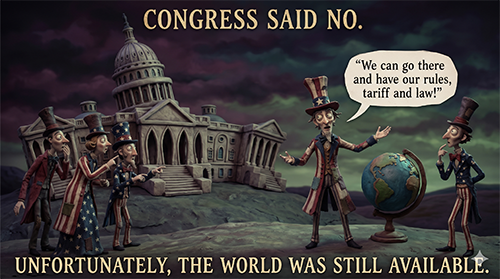
The White House announced today that losing control of Congress would not weaken President Trump. It would merely expand the geographical area in which everyone else experienced him.
“The American people have spoken,” a spokesperson explained. “The president respects their decision so deeply that he will spend the next two years speaking to other people.”
With domestic legislation facing resistance, the administration unveiled its new governing philosophy: abroad.
At home, a president must negotiate with lawmakers, answer awkward questions and occasionally encounter a document longer than a restaurant menu. Overseas, there are motorcades, ceremonial carpets and leaders sufficiently polite to postpone contradicting him until the translators have finished.
“Congress won’t approve my agenda,” the president reportedly told aides. “Have we tried a country without Congress?”
Peace Through Superior Branding
The centrepiece of the diplomatic offensive would be a grand bargain with Russia, described by officials as “historic”, chiefly because nobody had yet agreed on what it contained.
Ukraine would be consulted at an appropriate stage, possibly after the commemorative merchandise had shipped.
Negotiations over Iran would follow a similarly rigorous process: announce peace, accuse doubters of supporting war, and instruct diplomats to locate terms compatible with the announcement.
A proposed agreement would last indefinitely, or until the next president discovered a different pen.
Asked about bipartisan support, an aide clarified that the administration welcomed both parties: the party celebrating the deal and the party accused of sabotaging it.
Oversight: Now With Frequent-Flyer Miles
Meanwhile, congressional investigators prepared hearings into alleged conflicts of interest.
The White House denied that the president’s travel schedule was designed to avoid scrutiny.
“He is not fleeing oversight,” an official said. “He is making oversight obtain a passport.”
Committee chairs requested documents. The administration offered photographs of handshakes.
Investigators sought financial disclosures. They received a statement describing the president’s finances as “a tremendous expression of American leadership”.
Family members insisted that any resemblance between private commercial opportunities and official diplomatic destinations was simply evidence that good business sense and world peace occasionally booked the same hotel.
Affordability Will Arrive After the Surcharge
Back home, voters continued making the unhelpfully domestic observation that groceries cost money.
The administration explained that tariffs would restore prosperity by making imported goods more expensive until American alternatives became available at prices requiring a separate explanation.
Consumers were urged to distinguish between higher prices, which were unfortunate under previous administrations, and patriotic price elevation, which was an investment in greatness.
Democrats promised relief as soon as they settled whether tariffs were economically disastrous or economically disastrous only when imposed by Republicans.
Both parties agreed that working families deserved certainty. Neither wished to spoil the suspense.
Please Do Not Confuse the Pilot With the Aircraft
Foreign governments, meanwhile, were advised against mistaking one president for the entirety of America.
America still contained businesses, universities, courts, states and millions of people who had not personally approved the latest announcement.
Indian officials adopted a suitably comprehensive approach: engage Congress, cultivate industry, understand competing political factions – and keep someone permanently available to explain that the prime minister could not attend a surprise summit announced eleven minutes earlier.
Democracy, analysts concluded, had applied the brakes.
The president had requested a helicopter.