The Nirvik Bureau, Bhubaneswar, 7 November 2026
A Premier Institution, Now Offering Applied Contamination
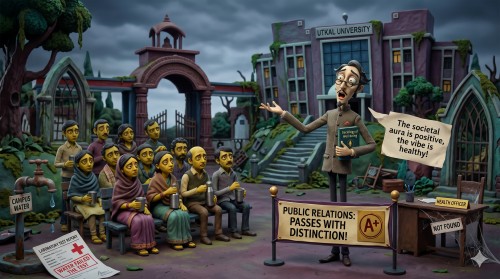
At Utkal University, interdisciplinary education has apparently reached the drinking-water supply. Sociology handles the explanation, public relations manages the reassurance, and students’ livers undertake the practical examination.
At least 12 students reportedly tested positive for jaundice. Of 19 water samples examined, two showed indicators of possible faecal contamination. For an ordinary institution, this might suggest a sanitation emergency. For a premier institution, it also presents an opportunity to announce that 17 samples did not.
Why dwell on two failures when there is such an impressive majority?
One awaits a prospectus celebrating an “overwhelmingly successful water-testing performance,” with the unsuccessful samples advised to apply for re-evaluation.
The Purifier Pursues Higher Studies
The reported findings included contamination in a deep borewell near Hostel 7 and a purifier serving a common canteen for Hostels 6 and 7.
A purifier is generally purchased to purify water. Here, it appears to have embraced a more academic role: reproducing the source material without critical intervention.
Perhaps it was conducting qualitative research.
The health official quoted in the report suggested that severe contamination of the source water could explain the purifier’s condition. This is an important distinction. The machine may not have abandoned its duties; it may simply have been overwhelmed by the university’s commitment to providing it with challenging assignments.
Students, meanwhile, had enrolled for degrees, not an immersive course in waterborne uncertainty.
Sociology Explains What Sanitation Must Fix
Enter assistant professor of sociology and media coordinator Papesh Kumar Lenka, who stated that the two contaminated sources were out of service and that the hostels received water from another borewell whose sample tested negative.
That clarification matters. A contaminated source is not automatically proof that students drank from it.
But so does the question behind the reassurance: how did campus water infrastructure acquire this distinction in the first place?
A media coordinator can legitimately communicate the university’s position. He cannot, through the transformative power of a statement, disinfect a borewell.
This is not a criticism of sociology. Sociology is admirably equipped to examine institutions, accountability and the distance between official descriptions and lived experience. It should not also need to supervise the plumbing.
What students require is accountability, preferably accompanied by safe water rather than another carefully balanced paragraph.
Out of Service, Still in the Syllabus
The report also mentions contamination near the hostels in 2024. Recurrence is an unfortunate word in public health, though universities usually admire continuity in academic programmes.
Health officials advised safe drinking-water provision, disinfection and investigation of the contamination source, including possible leakage from nearby septic tanks.
These measures lack the elegance of a press statement. They involve inspections, repairs and people accepting responsibility – activities notoriously difficult to complete through verbal clarification alone.
The university now has a straightforward examination: establish what happened, explain which supplies were used, fix the defects and publish clear follow-up results.
Until then, its most memorable lesson remains extracurricular:
When the water becomes questionable, make sure the statement is crystal clear. Till then ‘Happy Diwali’