
Dr Manoj Dash, Bhubaneswar, 9 November 2026
What did prehistoric humans and ancient Indian sages really eat? Available evidence challenges popular assumptions.
Imagine an ancient Indian sage seated beneath a banyan tree: silent, ascetic, sustained by fruit, roots and mountain air. Now picture a Vedic ritual in which cattle, milk, ghee and offerings of meat hold a central place.
Both images belong to India’s past. Neither tells the whole story.
Popular accounts often reduce ancient food to two simple stories: prehistoric humans as relentless hunters, or Indian sages as uniformly vegetarian forest dwellers. Archaeology and early texts suggest a more varied—and more interesting—reality. Human diets were shaped by geography, climate, season and culture. Ancient Indian religious life was equally diverse, changing over centuries rather than following one fixed dietary rule.
The Prehistoric Plate
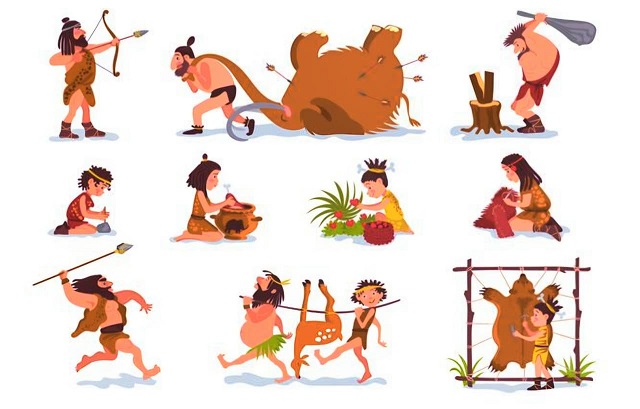
Between roughly 100,000 and 10,000 years ago, most human communities lived by hunting, fishing and gathering rather than farming. Their food could include wild fruits, berries, nuts, seeds, roots, tubers, leaves, edible grasses, mushrooms, insects, eggs, fish, shellfish and hunted animals.
But “the prehistoric diet” was never one diet. Communities in colder regions often relied more heavily on animal foods; those in warmer, plant-rich landscapes could obtain much of their food through gathering. Agriculture emerged only towards the later part of this long period.
Evidence from Neanderthals makes the variation vivid. A 2017 study by Laura Weyrich and colleagues, published in Nature, analysed ancient DNA preserved in dental plaque. It found a meat-heavy diet among Neanderthals from Spy Cave in Belgium. Neanderthals from El Sidrón in Spain, by contrast, showed evidence of forest foods, including mushrooms and pine nuts; the researchers found no meat in the samples from that particular group.
Another study, by Amanda Henry and colleagues in Proceedings of the National Academy of Sciences in 2011, identified plant remains in Neanderthal dental calculus, including starch grains showing evidence of cooking. The traces included grass seeds and legumes.
These findings do not merely add detail to a menu. They show that human populations living in the same broad prehistoric era could eat in markedly different ways.
Archaeology must still be read with care. Cut marks on bones, hunting tools and stable-isotope analysis can reveal animal consumption. Dental calculus can preserve evidence of plants. But plant remains decay far more easily than bones or stone tools. Their absence at a site does not prove that people did not eat plants.
The most reasonable conclusion is that prehistoric humans were opportunistic omnivores. They ate what their environment offered: sometimes relying heavily on meat, sometimes on gathered plants, and often on both. There is no scientific basis for claiming that all humans of this period were exclusively vegetarian—or exclusively carnivorous.
A Text Is Not a Menu
The picture becomes more complicated in ancient India.
The words Rishi, Muni, Tapasvi, and Sannyasi do not describe one homogeneous group of cave-dwelling ascetics. They refer to different religious, literary and social roles. Some sages may have lived in forests or remote places; others were householders, teachers, ritual specialists or members of settled communities. Nor should later epics and Puranas be read automatically as contemporary biographies.
The earliest Vedic literature, especially the Rigveda, reflects a society in which cattle, milk, ghee, grains and other foods mattered. Animal sacrifice also formed part of Vedic ritual practice. Jonathan Dickstein’s 2022 doctoral study, Animals in Hindu South Asia: From Cosmos to Slaughterhouse, examines evidence for animal sacrifice, domestication and consumption in Vedic and later Hindu traditions.
This does not establish that every Vedic poet or sage ate meat regularly. It does, however, make the claim that all early Rishis were strict vegetarians historically difficult to sustain.
The Brihadaranyaka Upanishad (6.4.18) offers direct textual evidence. It describes a ritual in which a couple seeking a learned and accomplished son are instructed to prepare rice with meat and ghee. The passage refers to the flesh of a young or mature bull.
This is a specialised ritual prescription, not evidence of the everyday diet of every sage. But it is important: it shows that the early Upanishadic textual world did not universally prohibit meat.
At the same time, Indian traditions contain powerful ideals of ascetic restraint. The Manusmriti, in its account of forest-dwellers, recommends vegetables, flowers, roots and fruits, and prescribes avoidance of meat. The Baudhayana Dharmasutra describes forest hermits who lived on wild grains, roots, fruits or edible forest plants. It also describes a category of hermits who consumed animals killed by predators.
A plant-based ascetic life was therefore a recognised ideal. But ascetic practice was not uniform. These are religious prescriptions and descriptions of particular disciplines—not dietary surveys proving what every historical Rishi or Muni actually ate.
The Slow Rise of Ahimsa
The development of ahimsa—non-injury—was gradual. It became increasingly prominent during the first millennium BCE, especially in the milieu of Jainism, Buddhism and other renunciant movements.
The Chandogya Upanishad includes non-violence among the virtues associated with religious discipline. Later Brahmanical texts increasingly praised abstention from meat; the Manusmriti, for example, praises the merit of avoiding it.
Yet the textual record remains complex. The same tradition can preserve permission for meat in particular ritual circumstances alongside praise for abstention. This is not evidence that vegetarianism was always universal. It is evidence of a changing and contested ethical landscape.
Nor should we assume that all early Buddhist monks were vegetarian. Early Buddhist disciplinary rules allowed monks to accept meat under specified conditions, provided they had not seen, heard or suspected that an animal had been killed specifically for them. Jain traditions developed an especially rigorous approach to non-injury, while different Hindu traditions adopted varying degrees of vegetarian discipline over time.
Vegetarianism in India was not a timeless default. It was a significant religious and ethical development—one that gained force over centuries.
Three Myths Worth Questioning
Prehistoric humans were not naturally vegetarian—or exclusively carnivorous. Their diets were adaptive, varied and shaped by local environments.
Ancient Indian sages were not one dietary category. Some forest ascetics followed disciplined plant-based diets; early Vedic ritual culture also included animal sacrifice and meat consumption.
A religious text is not a menu. It may recommend, permit, condemn or idealise a practice. It does not automatically tell us what its authors, teachers or wider society ate every day.
And one further caution: the absence of archaeological evidence is not proof that a food practice never existed. Food remains are unevenly preserved, and plants in particular often leave little trace.
What the Evidence Tells Us
Food habits in human history were never uniform. For tens of thousands of years, people survived through a flexible combination of hunting, fishing and gathering. Some communities ate substantial amounts of animal food; others relied heavily on plants. Most probably used a mixture, depending on what their ecosystem provided.
Ancient Indian sages cannot be placed in a single dietary box either. Some followed disciplined plant-based ascetic practices. Early Vedic ritual culture also included animal sacrifice and meat consumption. Over centuries, the ideals of ahimsa, compassion and vegetarianism acquired increasing religious and social importance—but their adoption was neither immediate nor universal.
Our ancestors were not cardboard figures in a modern dietary argument. They were adaptable people, shaped by scarcity, season, belief and place. Indian traditions, far from being frozen in a single dietary rule, gradually developed one of the world’s most influential ethical visions of restraint, compassion and the moral treatment of living creatures.
That history is more interesting than either myth. And it deserves to be understood through evidence, not assumption.