Nirvik Bureau, Bhubaneswar, 25th November 2025
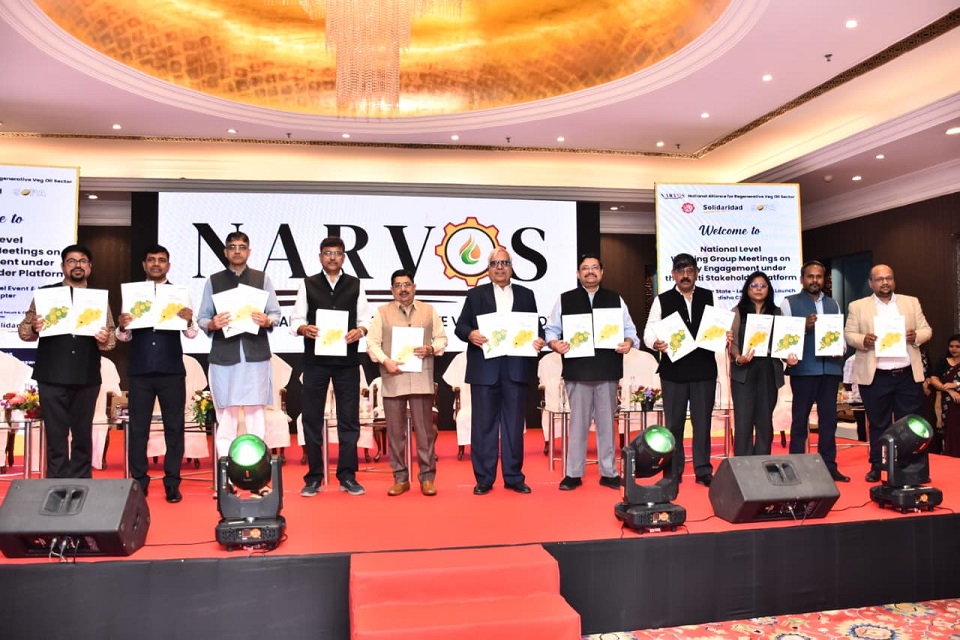
The National Alliance for Regenerative Vegetable Oil Sector (NARVOS), initiated by Solidaridad Asia and The Solvent Extractors’ Association (SEA) of India, today launched its Odisha Chapter at a state-level event held at Mayfair Convention, Bhubaneswar. The event marked a significant milestone in India’s journey towards regenerative, climate-resilient, and self-reliant edible oil production.
The launch was accompanied by the release of the joint Solidaridad–SEA study, “From Field to Fortune”, which outlines a clear pathway for transforming Odisha into a major contributor to India’s vegetable oil security through a proposed Odisha Edible Oil Mission (2025–30).
With 11.7 lakh hectares of rice fallows, ten diverse agro-climatic zones, and rapidly expanding cotton and groundnut regions, Odisha holds immense untapped potential to lead the next wave of regenerative oilseed expansion.
The proposed Odisha Edible Oil Mission aims to:
a) Convert 9.8 lakh hectares of rice fallows into productive oilseed cultivation.
b) Bridge the 58% yield gap using regenerative agriculture and improved seed systems.
c) Develop 100-150 FPOs for seed, aggregation, and processing enterprises.
d) Generate ₹49,410 crore in economic output and ₹6,770 crore in revenue for the State.
e) Reduce India’s edible oil import gap by 5.4% by 2030.
“Odisha has the natural strengths to become India’s Eastern Oilseed Powerhouse. Through regenerative agriculture, better seed systems, and strong farmer institutions, the state can rapidly scale production while restoring soil health and building climate resilience. NARVOS Odisha is not just a platform—it is a commitment to empowering farmers, strengthening rural enterprises, and helping India reduce its dependence on edible oil imports in a sustainable way,” said Dr. Shatadru Chattopadhyay, Managing Director, Solidaridad Asia in a recorded message from Sri Lanka.
He added, “Our study ‘From Field to Fortune’ clearly shows that with coordinated action—policy, industry participation, and farmer-centric investment—Odisha can unlock thousands of crores in value and become a national model for regenerative oilseed development.”
Shri Prashant Pastore, General Manger, Solidaridad highlighted on regenerative practices on oil seeds cultivation, while sharing the objectives of the programme. He emphasized on market driven approach in promoting oil seeds. He also briefed the participants on the overall session plans.
Dr. B.V. Mehta Executive Director, The Solvent Extractors’ Association of India, said that India imports nearly 60% of its edible oil requirement, and this dependency must be addressed urgently. Odisha offers a golden opportunity to accelerate domestic production through rice fallow utilization, improved processing capacities, and strong market linkages. SEA is proud to join hands with Solidaridad to launch NARVOS Odisha, which will bring together government, research institutions, and industry to build a robust ecosystem for oilseed growth. He further stated that the Odisha Edible Oil Mission is a visionary step. If implemented with focus and farmer participation, the state can significantly contribute to India’s edible oil security while creating rural jobs, enhancing incomes, and strengthening local enterprises.
Shri Dayananda Pathak, Executive Director, Soybean Processors Association of India (SOPA), stated that India aims to reduce its edible oil imports from the current 160 lakh tonnes to just 10–20 lakh tonnes. He also highlighted that soybean cultivation has strong potential in Odisha, particularly during the summer season in the western region of the state.
Dr. P. K. Rai, Director, ICAR–NIBSM, highlighted that increasing both the area and yield of oilseed crops must be the key priority, which can be achieved by ensuring an assured market for farmers. He emphasized the need to promote short-duration mustard varieties, select region-appropriate seeds, and adopt good agronomic practices. These coordinated efforts, he noted, can lay the foundation for a new Yellow Revolution.
Dr. Suresh Motwani, General manager from Solidaridad Asia, who has been mentoring the Odisha Programme since 2022, expressed confidence that with all key stakeholders coming together, the mission stands on the brink of remarkable success. He underscored that true transformation will be possible only when farmers, businesses, scientists, and government agencies work in complete synergy creating a unified, collaborative ecosystem capable of driving lasting impact across the oilseed sector.
Dr. Bishnu Prasad Pattanaik, Joint Director, Department of Agriculture, who is heading the Oil Seeds Mission in the state, pointed out that the unavailability of quality niger seeds remains a major concern, emphasizing the need to strengthen seed availability for this crop. He also stressed the importance of creating awareness among value chain stakeholders about oil extraction processes. In addition, he highlighted the significant potential of groundnut and avocado oil extraction as emerging opportunities in the sector.
Shri Shubhranshu Mishra, OAS, Addl. Secretary, Agriculture & Farmers’ Empowerment Department, who is also heading APICOL, the nodal agency promoting agri-allied entrepreneurship in the state, emphasized the importance of a holistic “Soil to Oil” approach, highlighting the need for cluster-based development and stronger linkages with FPOs. He stressed the potential of expanding oilseed cultivation through Crop Rice Fallow Management (CRFM) and underscored that policy decisions must always consider the needs and realities of those at the bottom of the pyramid
Shri Sobhan Kar, Chairman, Sarat Kar Anima Kar Foundation, shared that he has been associated with Solidaridad for nearly four years and has seen the organisation’s deep commitment to empowering rural communities. He highlighted that Odisha is richly endowed with natural resources, hardworking human capital, and immense untapped opportunities. Emphasizing the need to prioritize regenerative farming, he noted that sustainable practices can unlock long-term prosperity for farmers. He also appreciated the impactful efforts of the Dharitri Women FPO, calling it a powerful example of how women-led collectives can drive meaningful change at the grassroots level.
Shri Mehul Gupta, Director at PwC, highlighted the nutritional and environmental advantages of promoting oilseed cultivation. He also explained the rationale behind selecting Odisha for this initiative, noting its strong agricultural potential and conducive ecosystem. Furthermore, he outlined two key operational models to enhance efficiency in the sector: the Hub-and-Spoke Model and the Microenterprise-Based Cooperative Model.
Shri Gyana Ranjan Sarangi, Project Manager, Solidaridad focused on the formation of Oil Seeds Steering Group . He also embarked on the task of qualitative production of oil seeds by following cluster approach and FPO connect. A market-oriented strategy may be adopted to enhance the production and productivity of the oil seeds.
About NARVOS
The National Alliance for Regenerative Vegetable Oil Sector (NARVOS) is a collaborative platform anchored by Solidaridad Asia and the Centre for Responsible Business, with support from SEA, SOPA, and leading industry partners. NARVOS aims to revitalize India’s vegetable oil sector by promoting regenerative farming practices, enhancing farmer incomes, building climate resilience, and fostering responsible value chains.