The Nirvik Bureau, Bhubaneswar, 4 July 2026
India’s Most Profitable Silence
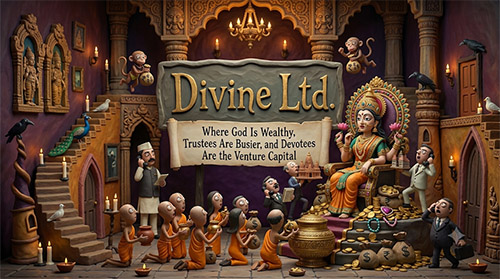
India has finally perfected a business model where the primary stakeholder never speaks, never audits, and never resigns. God, it turns out, is the ideal CEO—omnipresent in branding, completely absent in accountability.
With nearly Rs 9 lakh crore parked across temples, faith has quietly become India’s most stable asset class. No market crashes, no quarterly losses—just a steady inflow of guilt, gratitude, and gold.
And unlike taxpayers, devotees don’t even ask where their money goes. Because questioning divine finance is apparently more sinful than mismanaging it.
The Management of the Almighty
In any other country, managing this scale of wealth would require economists, regulators, and forensic auditors. In India, it requires a delightful mix of bureaucrats, politicians, hereditary claimants, and occasionally, a retired judge—because nothing says “divine order” like pending litigation.
Lord Shiva reports to a Commissioner in Varanasi. Lord Ram operates under a government-appointed trust. Lord Krishna, not to be left behind, now functions under judicial observation.
It is unclear whether these gods approve of their management teams, but given their silence, they have been unanimously reappointed.
Devotion: Now Digitized and Deductible
Temples have evolved. Gone are the days of anonymous offerings. Today, devotion comes with receipts, QR codes, and surveillance.
At Vaishno Devi, donation counting happens under paramilitary watch, with staff wearing pocket-less uniforms—as if the greatest threat to national security is a clerk smuggling divine loose change.
At Tirupati, offerings are so streamlined that God now accepts UPI. One imagines a future where prayers come with transaction IDs: “Dear Lord, please find attached my request along with a successful payment confirmation.”
Faith, it seems, has gone fully cashless—corruption, reassuringly, has not.
Gold, Glory, and Governance Failure
The real miracle is not that temples have so much wealth. The real miracle is how consistently humans manage to misplace it.
From stolen donations in Ayodhya to land disputes in Tamil Nadu, the system functions with the precision of chaos. Experts solemnly declare, “Not everyone is corrupt,” which is comforting in the same way a sinking ship is reassured that not all compartments are flooded yet.
Meanwhile, temple vaults overflow with gold that could fund public welfare, infrastructure, or at least functioning public toilets—but instead remain locked away, occasionally discovered like archaeological surprises in a country that forgot it was rich.
Who Owns God?
The eternal debate continues: should temples be run by the government, private trusts, or traditional custodians?
The government insists on control, perhaps because no other sector offers this combination of high revenue, low accountability, and guaranteed emotional returns.
Private trusts claim tradition. Courts claim neutrality. Everyone claims authority.
Only the devotee claims nothing—except a fleeting glimpse of the deity after standing in a six-hour queue that funds the entire enterprise.
The Final Offering
In the end, India’s temple economy runs on a simple principle: the less transparent the system, the more sacred it appears.
Devotees donate in the belief that God sees everything. Ironically, it is the only entity in the entire system that does not submit a report.
Perhaps the next reform should be simple: if humans insist on managing God’s money, they should at least try behaving as if God is watching.
Because right now, the only thing truly divine about the system is its ability to survive without accountability.