The Nirvik Bureau, Bhubaneswar, 25 July 2026
NEP, PM SHRI, and AI Textbooks Arrive; Answer Keys and Exam Papers Prefer to Travel Independently
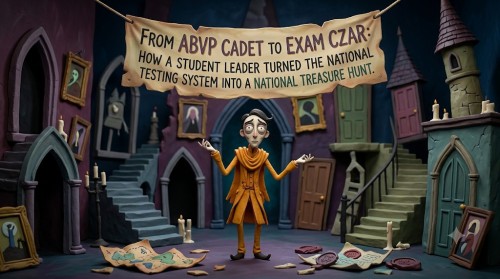
Dharmendra Pradhan’s political CV reads like a motivational poster for upward mobility: start a career shouting slogans in a college hall, end up signing memos from a cabinet room with a view. The only thing more ambitious than rolling out the National Education Policy was the country-wide ambition of thousands of question papers to go missing, wander off, or take a midevening stroll into the public domain – preferably when results were due.
As Education Minister, Pradhan evangelised multidisciplinary learning, mother-tongue arithmetic and the harmonising symphony of skill development with classroom theory. He announced initiatives with the panache of a festival MC: NEP here, PM SHRI there, an AI-tinged, multilingual e-textbook for every child, and possibly an app that would recite the national anthem while you did long division. The future, he promised, would be bright, digital, and employable.
The testing ecosystem, however, preferred a different syllabus – one of suspense, thrill, and plot twists. The National Testing Agency, which had been given the delicate task of determining futures by multiple-choice, discovered a new competency: creating mass protests. Where others saw leak, misprint, or mismanagement, the NTA found a way to mobilise youth energy more efficiently than any employment scheme ever could. Students who might have otherwise upgraded their CVs learned instead to upgrade their placards.
Protests served as practical pedagogy: urban camping at Jantar Mantar became an elective in civic theatre, hunger strikes counted as vocational training, and stone-throwing as an impromptu lesson in physics. Political operatives were thrilled – who knew that combining exam anxiety with street theatre could produce such high viewership?
When the Supreme Court admonished and then asked for explanations, officials discovered the classical administrative manoeuvre: appoint a committee. If the problem persists, appoint another, preferably chaired by a retired luminary whose memoirs will later include a chapter titled “How I Saved Nothing But Gave Opinions.” Reforms were pitched as structural, technological, and noble; the leaks, like stray answers, leaked on.
Pradhan’s defenders point to PM SHRI classrooms, DIKSHA modules and AI textbooks in regional tongues; critics point to students whose future trajectories now include “unemployed protest specialist” on LinkedIn. The minister, who once cut his teeth in student politics, seems to have rediscovered the old adage: teach a child to protest, and you’ll never be short of a voter base – or at least a news cycle.
In the end, his resignation – or strategic sabbatical, depending on the press release – read like the final exam of a long course in modern governance. The syllabus included innovation, big launches, and an advanced module in crisis-generation. Graduates of the Pradhan era will leave with mixed diplomas: a certificate in NEP rhetoric, a minor in digital rollout, and a PhD-level expertise in how not to run high-stakes examinations.
If there’s a moral here, perhaps it’s this: you can reform education from the top down, but you cannot reform the human proclivity to look for shortcuts on an answer sheet – or the political talent for turning every policy into a plot twist worth protesting.