The Nirvik Bureau, Bhubaneswar, 25 August 2026
Now served fresh: soap in dispensers, thermometers in fridges, and a sudden spiritual awakening about cockroaches.
The Great Hygiene Festival
The Food Safety Administration has discovered an extraordinary public-health intervention: sending inspectors outside.
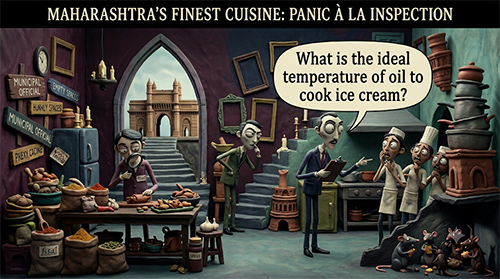
Since the Maharashtra FDA intensified raids, restaurant kitchens across the state have experienced scenes of sudden moral transformation. Refrigerators have remembered their purpose. Hand-wash stations, long considered decorative fountains of dust, have begun receiving both soap and water. Staff members have learned that hairnets are not merely festive headbands reserved for government visits.
More than 3,000 inspections reportedly produced 165 licence suspensions and 750 improvement notices. This proves that Indian restaurants are perfectly capable of maintaining hygiene – provided someone in a government badge is within a five-kilometre radius.
The rest of the year, apparently, food safety is an optional side dish.
“Pest Control? We Thought You Meant Customers”
At the venerable Poona Guest House, the owner reportedly checks refrigeration temperatures, cooking-oil registers, pest-control schedules and staff hygiene. This is admirable, though it raises a troubling question: must basic cleanliness now be celebrated as if somebody has invented electricity?
A restaurant that stores food safely should not qualify for a civic award. It should qualify as a restaurant.
Yet we have created a majestic national ritual in which kitchen hygiene arrives with the raid notice. On Monday, the cook stirs curry with the confidence of a medieval alchemist. On Tuesday, an inspection team appears. By Wednesday, the outlet has become a Scandinavian laboratory: stainless-steel boards, labelled containers, colour-coded bins, gloves, caps, thermometers and an employee called “Food Safety Officer” who was previously the cashier.
The cockroaches, naturally, are asked to take leave until further notice.
The Licence: A Certificate of Potential Good Behaviour
India has licences, regulations, checklists, certificates, advisories, training sessions, notices, warnings and, somewhere beneath a stack of files, an actual food-safety system trying to breathe.
But a licence does not mean safe food. It means the business has successfully filled out forms proving that it may one day consider safe food.
This is the beauty of compliance culture: the register is immaculate, the refrigerator may be warm, and the staff may not know why either fact matters. A thermometer can hang inside a fridge like a framed family photograph—present, respected, and never consulted.
Food-safety training too risks becoming a grand ceremony of certificate collection. The employee learns about cross-contamination in a classroom, receives a laminated badge, returns to the kitchen, and immediately uses the same knife for chicken, salad and perhaps the manager’s birthday cake.
Raids Are Not a Hygiene Plan
Raids can frighten businesses into action. Fear is, after all, India’s most efficiently implemented public policy. But a system that works only during a crackdown is not a system; it is a seasonal theatre production.
“Clean Kitchen Week” cannot be the annual equivalent of Diwali cleaning – an occasion when every stain is removed, every drain is scrubbed, and every expired packet is hurriedly relocated to a less visible corner of the universe.
The real test is what happens at 11:40 pm on a humid Wednesday, when the inspector is home, the owner is asleep, the delivery app is screaming for orders, and the kitchen boy has just dropped a spoon into the drain. Does the spoon return to service after a wash – or after a philosophical wipe on an apron?
That is food safety.
The Menu Must Change
The state needs faster testing, credible laboratories, risk-based inspections and consequences that arrive before the evidence becomes antique. Serious hazards deserve swift action; minor defects deserve time-bound correction, not public execution by viral video.
But businesses need a simpler lesson: hygiene is not a special performance for officials. Safe food is not a favour to customers. And cleanliness is not an emergency renovation triggered by the sound of government vehicles parking outside.
Until that becomes routine, Maharashtra’s restaurants will continue offering their most popular combo: one plate of vada pav, one paper napkin, and one surprise inspection-induced conscience.