
The Nirvik Bureau, Bhubaneswar, 26 July 2026
Young people bring parents, placards and premium meme-making skills to the ancient art of Public Discomfort
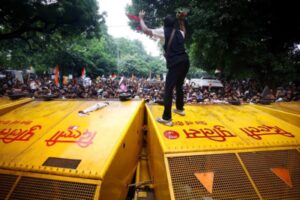
They came in hordes – different shades of despair, all holding phones like talismans and hope like a second-hand degree. At Jantar Mantar, the modern agora where 18th-century stone instruments watch a 21st-century identity crisis unfold, the new protester arrived fully formed: terrified of the future, fluent in sarcasm, and able to livestream their moral panic in eight filters.
Chinmoy, 21, arrived with his mother because nothing says “youth rebellion” like family logistics and parking at Dad’s office. He studies Electronics and Communication Engineering – which, in India’s job market, translates to “qualified for existential dread and part-time delivery.” Shivam’s fear is focused, practical and heartbreakingly millennial: what if he becomes a Rapido driver and his parents cry? This is less a political demand than a plea to the universe for a salary band that matches parental expectations.
Nearby, Arsh, fresh out of Kanpur tech-league, confided his specialty: anxiety. He has been rehearsing disappointment since college, where internships multiply like mushrooms and salaries remain stubbornly medieval. AI, leaked exam papers, and internships posing as employment are not plot devices here; they are the generational weather. So he follows Abhijeet Dipke on reels – because every movement needs a founder with a tweet and a catchy bug metaphor. “What if all cockroaches come together?” is both a rallying cry and a start-up pitch for collective survival.
At night, the camp becomes a cross-generational wellness retreat. Mothers knit their worry into thermals and tents; documentary filmmakers curate the mood lighting; Dalit and Ambedkarite groups claim the mic and insist that this isn’t just a middle-class pop-up. People who have been told to be grateful for crumbs now queue for the mic like it’s a free sample at a food festival of futures.
The protest choreography is familiar and oddly modern. There are placards with acerbic one-liners, speeches with ancestral references, and teenagers who have discovered civic duty between meme drops. They sleep on stone slabs and tarpaulins, then wake to create memes that will console them when the movement becomes a trending hashtag and then, predictably, an archived subthread in a national heatwave of outrage.
The police show up with lathis and institutional gravity; the protesters answer with creativity, petitions, and playlisted rage. Parents appear and sit beside their children, which changes the optics and the argument: this is now both a political mobilization and a family weekend. For many, protest is the first place where solidarity smells less like ideology and more like chai and shared charging ports.
Chitra will tell you this protest makes Delhi’s segmented soul visible: everyone brings their own grievances, assembles them into an imperfect collage, and calls it a movement. That’s true. But it’s also true that this generation has perfected the low-cost, high-impact protest economy: bring your own tent, charge your phone, shout until your voice goes hoarse, then monetise the mood with a viral meme. Revolt, after all, needs an audience – and an impeccable content calendar.
So they stay. They chant. They post. They sleep. They worry. They love. They ask for resignations, fairness, and decent chances to live without rehearsing precarity for a lifetime. And when the sun sets over the observatory, the stone instruments record nothing but echoes – the kind that will live on in screenshots, not policy briefs. The protesters know that real change is slow; they also know Insta-stories vanish in 24 hours, which is why they save everything to drafts and to memory.