
The Nirvik Bureau, Bhubaneswar, 22 July 2026
A Bowl of Rice, A Barrel of Ambition
Odisha has always known the quiet dignity of pakhala – a humble bowl of fermented rice that cools the body and humbles the ego. It required no branding, no ambassadors, and certainly no event managers with PowerPoint presentations. For centuries, pakhala survived on the radical marketing strategy of being edible, affordable, and real.
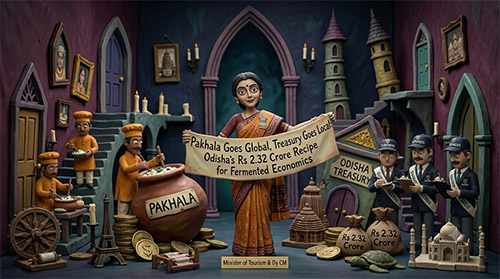
But in 2026, the state government decided this simplicity was unacceptable. How can something so modest exist without a budget of Rs 2.32 crore? Thus began Odisha’s bold experiment: converting a poor man’s lunch into a rich man’s invoice.
From Probiotic to Profitbiotic
The Tourism Ministry, in its visionary zeal, realized that pakhala’s biggest problem was not obscurity – it was insufficient expenditure. After all, what is culture if it cannot be itemized?
So, Rs 86 lakh went to an event company younger than most Instagram influencers, while Rs 68 lakh went to the official tourism body to presumably supervise the supervising. This dual-engine governance ensured that accountability, like the rice, was thoroughly fermented and untraceable.
Meanwhile, Odisha’s own cooks – who have been making pakhala since before hashtags were invented—were politely ignored. Authenticity, it seems, must now be flown in from Delhi at Rs 3 lakh in airfare, nourished with Rs 9.5 lakh worth of hotel cuisine that almost certainly did not include pakhala.
Influencers of Fermentation
No modern cultural event can survive without influencers – those brave digital explorers who travel across states to photograph food they do not eat. For a modest Rs 8 lakh in “souvenirs,” these ambassadors of content ensured that pakhala reached its rightful audience: people who will double-tap anything.
Their contribution was invaluable. Without them, how would the world know that Odisha can spend crores to prove it already eats rice?
Guinness World Record: Because Size Matters
The crowning achievement of this gastronomic opera was a Guinness World Record for assembling 1,174 kg of pakhala in a single container. Not for taste, not for innovation, not even for feeding people – just for size.
This is a significant milestone. It firmly establishes Odisha as a global leader in the field of “large quantities of things already available in smaller quantities.”
The Rs 32 lakh reportedly spent on acquiring this certificate raises philosophical questions. Is a world record still a record if it requires a procurement process? And more importantly, does the rice feel different knowing it is internationally certified?
Feeding the Poor, Expensively
The event fed 2,000 people. A noble goal, until one does the arithmetic: roughly Rs 12,000 per meal.
At this price point, each serving of pakhala should have come with a complimentary air conditioner, a framed certificate, and perhaps a short documentary on its own journey from pot to plate.
Instead, what the state achieved was something far more profound: it demonstrated that even the simplest act – feeding the poor – can be transformed into a premium experience when filtered through bureaucracy.
Branding the Obvious
The most touching aspect of this entire exercise is its stated goal: to popularize pakhala. In Odisha.
This is akin to organizing a campaign to introduce water to fish, or sunlight to the sun. One can only admire the confidence.
If branding is about storytelling, then Odisha has succeeded brilliantly. The story is no longer about pakhala as a people’s food. It is now about pakhala as a fiscal event – where every grain carries the delicate flavor of public expenditure.
The Final Taste
In the end, pakhala remains what it always was: simple, sustaining, and honest. It is everything the event was not.
But perhaps that is the real achievement. The government has managed to prove that while pakhala cools the body, governance can still raise the temperature.
And somewhere, in a quiet Odia household, a bowl of pakhala sits on the floor – unbranded, unrecorded, and blissfully unaware that it is now a luxury commodity worth Rs 12,000 per serving.