
The Nirvik Bureau, Bhubaneswar, 25 March 2026
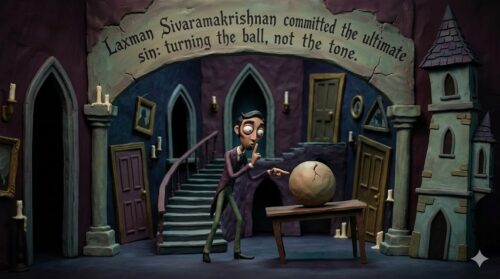
In a country that worships fair-skin fairness creams and dark-skin fast bowlers, Laxman Sivaramakrishnan committed the ultimate sin: turning the ball, not the tone.
In the great Indian cricket fairy tale, God is usually a fair, right-handed batsman who went to the right school and says “yaar” with the correct English accent. Everyone else is supporting cast: tall fast bowler, humble wicketkeeper, and, of course, the dark guy who proves we are not racist by being occasionally allowed to bowl the 12th over from the less windy end.
Enter Laxman Sivaramakrishnan, 17 years old, turning the ball and heads, but unfortunately not the melanin chart in the selection meeting. He took 12 wickets in a Test at 19, stumped Imran in Sharjah, embarrassed Miandad in Melbourne, and still had to wait outside a Mumbai hotel gate while the security guard decided whether “India cricketer” was available in his colour palette. The guard, of course, was only doing his national duty: protecting the property from underage, overqualified, insufficiently fair intruders.
Inside the dressing room, the jokes swung more than his leg-breaks. “Kalia, tera kya hoga” from the stands; “dark chocolate cake for a dark boy” from a teammate at his 17th birthday. This is what we proudly call “changing room banter” – an elite Indian tradition where trauma is manufactured locally, without any foreign investment. The captain ordered a cake; the team ordered a personality disorder. Efficiency.
When he went to the West Indies, everyone was dark and suddenly nobody cared. There, Malcolm Marshall and Desmond Haynes took him out, not to teach him how to lighten his skin, but how to enjoy it. Gordon Greenidge, himself seasoned by English racism, advised him to mind his business and play his cricket — which, in Indian translation, means “please adjust, yaar.” For the first time, he was more comfortable in the opposition dressing room than in his own. Nothing screams “team culture” like feeling safer with the guys trying to get you out.
Back home, his body grew two and a half inches, but sports science hadn’t yet been invented for non-fair players. No biomechanics expert, no physio, no analyst — just ice packs, painkillers, and gossip. When his rhythm went, the rumours came: success gone to his head, drinking, drugs, moral collapse. Apparently, hotel staff across continents were secretly serving contraband whisky to a 19-year-old because that’s obviously easier than just admitting the system failed him.
He finished international cricket at 21, then graduated to that famous Indian rehabilitation centre: “corporate job + Kinetic Honda + 8,000 rupees salary.” His parents put out a matrimonial ad: Test cricketer, owns flat, seeks bride. The post box came back emptier than the BCCI’s anti-discrimination handbook. Reputation travels faster than a googly.
Two decades later, he reinvented himself as a commentator, honing his English, learning the craft, spending 23 years behind a mic. The ball was no longer allowed to drift, but the bias still did. He alleges that in all those years he was never allowed to do the toss or the presentation – newcomers, mysteriously fairer and more “presentable,” kept getting those shots. When a fan hinted that maybe his skin colour was the issue, he replied: “You are right. Colour discrimination.” The response from the system? A perfectly polished sentence: “We have never discriminated against anybody.” That’s the thing about institutional colourism – it comes with flawless PR and SPF 50.
So now, at 60, he’s cleared his house of trophies, photos, bats, and Man of the Series awards. The game that soaked his life in glory also marinated it in insult. He kept giving the mementos away; only the memories refused to leave. The country kept the highlights, he kept the nightmares.
Today he plays golf, a sport mercifully indifferent to skin tone as long as the polo T-shirt is branded. The same hands that made Imran Khan look mortal now grip a seven-iron in silence. It’s the silence of a man who did everything right — except being born in the wrong shade of “blue jersey compatible.”
But don’t worry. As we rush to defend ourselves on social media, we can proudly say: “India is not racist. We made a fairness cream cricketer our brand ambassador.” The ball turned. The country didn’t.