The Nirvik Bureau, Bhubaneswar, 31 May 2026
Ministers of Spin, Lords of Lobbying and Gurus of Convenient Memory convene to pass landmark legislation – chiefly, the art of looking busy.
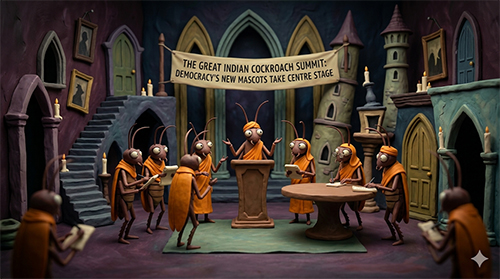
They arrived not on flying carpets but in SUVs with tinted windows and immaculate masks of civic concern. The cockroaches of India – seasoned practitioners of “let’s-sit-together-and-not-decide,” champions of the U-turn, and inventors of the strategic half-smile – gathered for what the press release called “National Consensus on Forward Movement.” Cameramen flashed, anchors nodded solemnly, and the tea was exactly as ambiguous as the agenda.
The host, Honourable Sir Smooth-Talk, opened by praising the nation’s resilience and then described resilience as “flexible patriotism that adjusts with the weather.” He proposed a new national slogan: “Sabka Saath, Sabka Spin.” The slogan was instant hit; a jingle was commissioned, to be sung in seven languages and three dialects of plausible deniability.
First item: Fiscal Fitness for Families Who Own Fortune. Delegates debated whether unexplained wealth should be categorized under “legacy assets” or “family entrepreneurship.” A clever committee suggested renaming tax audits as “caffeine-free conversations.” The Finance Wing recommended a new tax term – “evade-lite” – aimed at citizens who merely forgot where they hid their ledgers.
Next up: Freedom of the Fourth Estate (and How To Give It Context). The Ministry of Narrative proposed a press fellowship: every journalist would be offered a “clarity kit” – a glossary where “scandal” reads “temporary narrative misalignment” and “investigation” reads “extended consultation.” News anchors were advised to adopt the ancient practice of editorial respectability: raise voices dramatically, soften conclusions softly.
A special panel addressed Environment and Other Suggestions. A representative from Industry confessed that rivers were a bit tired, then recommended a study on whether rivers could be taught to flow seasonally. The group endorsed “green growth,” defined as planting saplings on political posters. A flagship policy – Clean Air by Committee – promised to appoint subcommittees until the smog politely reduced its opacity.
On Accountability and Related Innovations, a senior member unveiled a breakthrough: the Apology Index. Apologies would now come with tiered certifications – “Oops” (bronze), “Sincere Oops” (silver), and “Seasonal Oops” (platinum), the last reserved for election cycles. The Ethics Wing announced an app where citizens could swipe right to accept apologies or swipe left to file a form, which would be answered within an electoral term or two.
Cultural Exchange was lively. State ministers taught ancient arts: how to schedule public hearings during cricket matches, how to adjourn Parliament with ceremonial flourishes, and how to transform whistleblowers into weather reports. Workshops included “How to Nod While Doing Nothing” and “The Gentle Art of Blaming Previous Administrations (with charts).” Schoolchildren watched on livestream and took notes for future careers.
In the evening, the summit adopted a visionary document: The Delhi Declaration on Responsible Ambiguity. It contained clauses like “We uphold transparency in spirit,” “We support the rule of law, subject to context and optics,” and “We will consult stakeholders – especially stakeholders who funded consultation.” The declaration was printed on recycled affidavits.
As dignitaries left in convoys, each received a souvenir: a tiny trophy engraved ‘For Services to Staying Evasive’ and a booklet, Looking Busy: A Politician’s Handbook. Back home, citizens opened their own windows, breathed the mixed air, and wondered if this unity of cockroaches might yield one tangible improvement – perhaps a government-issued broom with a dignity slot.