Ambika Prasad Kanungo, Bhubaneswar, 23 August 2026
India’s mineral wealth may lie beneath the soil of individual States, but its economic importance extends far beyond their borders. Nowhere is this contradiction more visible than in Odisha. The State’s iron ore feeds India’s steel industry, its coal supports the country’s energy needs, and its chromite, manganese and bauxite underpin strategic and industrial supply chains. Increasingly, critical minerals are becoming indispensable to electronics, renewable energy, electric mobility, and national security. Yet while the economic benefits of Odisha’s minerals are national, many of the costs remain local. Mining districts live with depleted forests, damaged roads, pressure on water resources, pollution, displacement, and the disruption of traditional livelihoods. This makes the debate over the Mines and Minerals (Development and Regulation) Amendment Bill, 2026 far more consequential for Odisha than a routine dispute over mining taxation.
At its core, the controversy raises a fundamental federal question: when a State bears the environmental, social, and infrastructural costs of extracting a resource that serves national economic interests, how much of the economic value of that resource should remain within the State?
Odisha is at the centre of the debate
For Odisha, this is not an abstract constitutional argument. Mining has become one of the principal pillars of the State’s economy. Odisha is among India’s leading producers of iron ore, chromite, bauxite, manganese, and coal. Mineral resources have financed infrastructure, welfare programmes and public investment and have helped Odisha emerge as a major industrial destination. But this dependence also creates vulnerability.
The State’s fiscal fortunes are closely linked to the mining cycle. When mineral prices and production remain buoyant, government revenues rise sharply. When the sector faces a downturn, the impact is felt across public finances. The question, therefore, is not simply whether Odisha earns royalty from mining. It is whether the State retains sufficient fiscal space to deal with the long-term consequences of extraction.
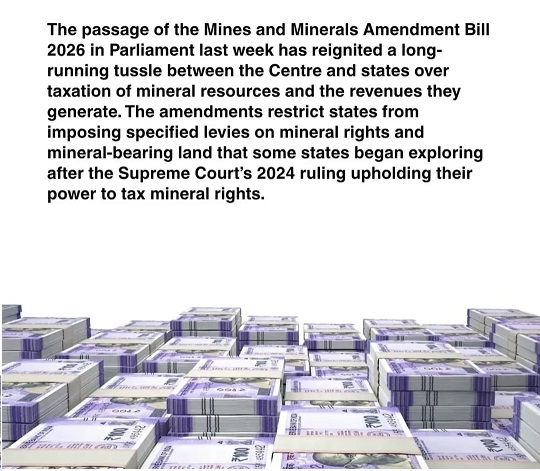
Political debate in Odisha has cited a possible annual revenue implication of around ₹12,000 crore, while mineral-related dues have been projected at more than ₹1 lakh crore. These figures represent different categories and should not be treated as an immediate or automatic loss to the State exchequer. But even allowing for differences in calculation, they demonstrate why the issue has acquired such political and fiscal significance.
For a State whose mineral resources have contributed substantially to national industrialisation, any restriction on its ability to derive revenue from those resources deserves particularly close scrutiny.
The Centre’s case is not without merit
The Union government has a legitimate argument. India needs a predictable and competitive mining regime. Multiple State-level levies can increase the cost of extraction, create uncertainty for investors and generate prolonged litigation. The country is also entering a new phase of mineral competition. Critical minerals are becoming strategically important as India expands renewable energy, electric mobility, advanced manufacturing, and defence production.
A fragmented fiscal regime could undermine these objectives. But uniformity of rules does not necessarily require uniformity of fiscal power. A national mining policy can establish common standards for exploration, environmental compliance, auctioning, and development without automatically extinguishing the legitimate fiscal interests of mineral-producing States. This distinction is particularly important for Odisha.
The constitutional question
The controversy assumes greater significance in the light of the Supreme Court’s landmark judgment in Mineral Area Development Authority vs. Steel Authority of India Ltd. In July 2024, a nine-judge Constitution Bench, by an 8:1 majority, held that royalty is not a tax and recognised the States’ legislative competence to tax mineral rights under Entry 50 of the State List, subject to constitutional limitations. The Court subsequently permitted States to raise certain demands from April 1, 2005, with payments allowed to be staggered over twelve years beginning in 2026.
The timing is significant.
The Court’s judgment reaffirmed an important aspect of fiscal federalism: mineral-bearing States are not merely administrative units through which national mineral policy is implemented. They have constitutionally recognised interests in the economic activity taking place within their territories.
The amendment, by restricting specified State taxes, cesses, and levies relating to mineral rights and mineral-bearing land, therefore, enters a constitutional space that has only recently been examined by the Supreme Court. The provision invalidating certain unpaid or unrecovered State levies from earlier years, while protecting amounts already collected from refund claims, makes the issue even more contentious. Further legal and constitutional scrutiny cannot, therefore, be ruled out.
Odisha’s dilemma: development versus dependence
There is, however, another dimension that Odisha cannot ignore.
For decades, the State has pursued mineral-led industrialisation. The strategy has brought investment, steel plants, power projects, roads, and employment. But it has also produced a familiar paradox: the districts that generate enormous mineral wealth are often the places where poverty, environmental degradation, and infrastructure deficits remain most visible. This is the real fiscal question.
Revenue from minerals should not merely be viewed as money entering the State treasury. It is a mechanism through which the State can compensate for the economic and ecological costs of extraction. A mining truck damages a rural road. A mine places pressure on groundwater. A project requires land acquisition and rehabilitation. Mining activity increases demand for health, education, sanitation, and civic infrastructure. Forest-dependent communities face disruptions that cannot always be measured in conventional fiscal accounts.
Who pays for these consequences? If the State is expected to bear a substantial part of the cost, it must retain adequate fiscal capacity.
The political contradiction
The political response in Odisha has been sharply divided. The Biju Janata Dal and other critics have argued that the amendment could erode Odisha’s financial interests and weaken the State’s capacity to invest in development. Questions have also been raised about parliamentary scrutiny and the manner in which the legislation was passed.
The Odisha government, on the other hand, has maintained that the amendment will not adversely affect the State’s revenue and has supported the argument that a transparent and stable framework is necessary to attract mining investment. Both positions need to be tested against facts rather than political claims.
If there is no significant revenue impact, the State government should place detailed calculations in the public domain. If there is a substantial impact, the Centre and the State should explain how the resulting fiscal gap will be addressed. For Odisha, assurances are not enough. Transparency is essential because mineral revenue is public wealth.
Who bears the cost of national mineral security?
This is perhaps the most important question emerging from the controversy. The Centre rightly argues that minerals are increasingly a matter of national economic and strategic security. But national security cannot mean that the States where minerals are extracted become mere suppliers of raw materials while bearing disproportionate social and environmental costs. Odisha has already experienced this tension.
The State has supplied iron ore, coal, chromite, and other minerals essential to India’s industrial growth. But mining-intensive districts have simultaneously confronted deforestation, pollution, displacement, and pressure on basic infrastructure. If mineral resources are treated as a national strategic asset, then the fiscal architecture surrounding them should also reflect the national responsibility for the costs of extraction.
That means stronger mechanisms for revenue sharing, environmental restoration, rehabilitation, and development of mining-affected regions—not simply greater central control over the fiscal framework.
A test of cooperative federalism
The MMDR Amendment should, therefore, be viewed through a wider lens than mining regulation. India needs a competitive mining industry. It needs investment. It needs critical minerals. It needs national standards and a coherent regulatory framework. But it also needs financially viable States.The answer cannot lie at either extreme—neither unrestricted State taxation nor excessive centralisation.
A better model would allow the Union to establish broad national rules while preserving meaningful fiscal space for mineral-producing States. The principle should be simple: States that bear the costs of resource extraction must receive a fair and predictable share of the value generated by those resources. For Odisha, this is particularly important because its mineral wealth is finite, while the environmental and social consequences of extraction can last for generations.The State must therefore ask a deeper question than how much revenue it may lose in a particular financial year. It must ask whether its long-term fiscal and developmental interests are adequately protected in a system where its natural resources increasingly serve national strategic objectives.
The MMDR Amendment is consequently more than a mining-sector reform. It is a test of India’s federal compact.
Minerals may lie beneath Odisha’s soil, but their value extends across India. The real test of cooperative federalism is whether the benefits and burdens of that mineral wealth are shared fairly. If the economic benefits are national but the environmental and social costs remain predominantly local, fiscal federalism must provide the balancing mechanism. For Odisha, that balance is not merely a constitutional principle. It is a question of economic justice, fiscal autonomy, and the future of a State whose mineral wealth has powered India’s growth for decades.