
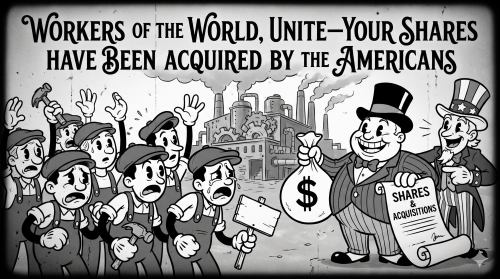
The Nirvik Bureau, Bhubaneswar, 31 October 2026
The revolution will not be nationalised. It will be rebranded.
The Red Scare Gets a Golden Share
America has discovered a foolproof way to prevent socialism: elect a man who can buy it, rename it and accuse the opposition of importing it.
Ahead of the midterms, Donald Trump has warned that Democrats are bringing communism to America. This is alarming news for an administration apparently determined to ensure that, when communism arrives, the federal government already owns a strategic stake in the reception desk.
The distinction is straightforward. When Democrats propose government intervention, it is a mortal threat to liberty. When Trump acquires corporate stakes, it is the art of the deal.
One involves sinister bureaucrats interfering with the market. The other involves patriotic bureaucrats interfering with the market while standing beside a flag.
The Invisible Hand Gets a Supervisor
For decades, Americans were taught that the invisible hand allocates resources better than Washington.
Unfortunately, the invisible hand failed to attend several important meetings and has now been placed under federal supervision.
Consider the government’s “golden share” associated with the US Steel takeover. Ordinary shares offer dividends. A golden share offers something considerably more American: the ability to tell everybody else what they cannot do.
Critics might call this state control. That is unfair. State control wears a grey suit and speaks about five-year plans. A golden share wears a red tie and speaks about winning.
Entirely different tailoring.
Then came the government’s stake in Intel. Apparently, the best defence against centrally planned economies is to have Washington centrally plan which semiconductor company deserves an equity investment.
The chips, at least, will know who their president is.
Socialism, but Please Use the Executive Entrance
The difficulty with socialism has always been its branding.
“Public ownership” sounds like a municipal swimming pool. “Strategic federal equity participation” sounds like something a billionaire might discuss aboard a yacht.
This is why an unemployed worker seeking government assistance must first demonstrate moral character, while a corporation seeking government investment need only demonstrate strategic importance.
A useful rule emerges: if the recipient has a kitchen, it is dependency. If the recipient has a boardroom, it is industrial policy.
Under the emerging doctrine of Trumpitalism, the state may enter the marketplace provided it remembers to denounce its own presence.

A Revolution Without the Inconvenience of Equality
Purists will object that a few corporate stakes do not make America socialist. Quite right. Workers have not seized the means of production. They have merely been invited to cheer while the government negotiates ownership terms.
There are no bread queues in this revolution. Only shareholders queuing to discover whether Washington is their regulator, investor, customer or all three.
Meanwhile, Democrats face a messaging crisis. How can they campaign for greater government involvement when their opponent has already acquired the involvement and reserved the naming rights?
The midterms therefore offer voters a historic choice: government intervention condemned as socialism, or government intervention celebrated as its defeat.
America remains the land of the free market.
The market is free to do whatever it likes.
Subject, naturally, to presidential approval.