
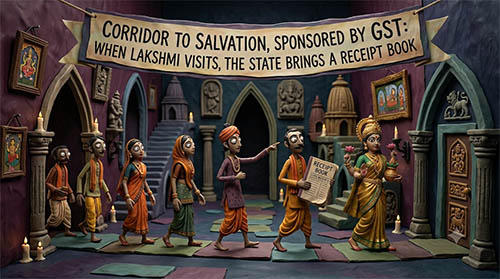
The Nirvik Bureau, Bhubaneswar, 5 July 2026
In Odisha, Lakshmi has finally received what centuries of devotion could not secure for her: a budget allocation.
For years, she wandered into the huts of the poor, sat beside Sriya, and upset divine hierarchies with the quiet audacity of compassion. But in 2026, she has been given something far more powerful than moral authority – a ₹28 crore corridor, complete with administrative oversight and, one assumes, adequate parking.
The state has stepped in, as states do, to improve upon mythology.
Balaram Dasa, who once translated rebellion into poetry, might be relieved to know that his inconvenient little text – where gods are forced to apologise to a Dalit woman – is now safely housed within a government-approved narrative of “cleanliness and women’s empowerment.” Nothing disrupts caste quite like a well-sanitised slogan.
From Insurgency to Infrastructure
The Lakshmi Purana was never subtle. It did not merely suggest reform; it staged divine embarrassment. Jagannath himself was made to confront prejudice, not through a committee, but through hunger and exile.
Today, however, such unruly storytelling requires management.
Enter the Corridor.
Corridors, in modern governance, are where ideas go to become photogenic. They are long enough for ribbon cuttings, wide enough for camera angles, and hollow enough to echo with phrases like “heritage revival” without the nuisance of historical context.
In this version, Lakshmi may still visit Sriya—but preferably after obtaining clearance from the Tourism Department.
One Crore Copies, Zero Discomfort
The promise to distribute one crore copies of the Lakshmi Purana is admirable. After all, nothing says social transformation like mass printing.
One assumes these copies will be carefully curated to ensure that readers are inspired, but not unsettled. The part where gods uphold caste hierarchy may be retained as “historical context,” while the part where they are humiliated for it may be gently reframed as “symbolic learning.”
Revolutions, after all, must be made syllabus-friendly.
Pakhala, Platter, and the Price of Pride
Meanwhile, not far from this corridor of enlightenment, the state demonstrated its cultural commitment through a ₹2 crore celebration of Pakhala Dibasa.
For a dish whose essence lies in simplicity – fermented rice, water, and time – the government wisely added what tradition lacked: event managers, supervision charges, and a Guinness World Record.
Nothing validates heritage quite like international certification.
Anthropology may debate Pakhala’s place in agrarian life, but the ledger is clear: ₹31 lakh for a certificate, and not a rupee wasted on asking grandmothers how they actually make it.
The State as Devotee-In-Chief
There is something touching about the state’s enthusiasm. It does not merely govern; it performs devotion.
It builds corridors, hosts festivals, prints scriptures, and occasionally, almost accidentally, remembers what these things were originally about.
But devotion, when administered, acquires peculiar habits. It prefers spectacle over substance, slogans over scholarship, and announcements over arguments. It reveres culture most when culture does not talk back.
Which is precisely the problem with the Lakshmi Purana.
Because at its heart is a woman who refuses to stay outside the temple.
Sriya at the Gate
And so the final image writes itself.
A gleaming corridor stands at Balaram Dasa’s birthplace. Tourists arrive. Cameras click. Speeches are delivered. Lakshmi is praised as a symbol of empowerment.
And somewhere, just beyond the ceremonial entrance, Sriya is still waiting.
Not for entry – she has already earned that – but for acknowledgement.